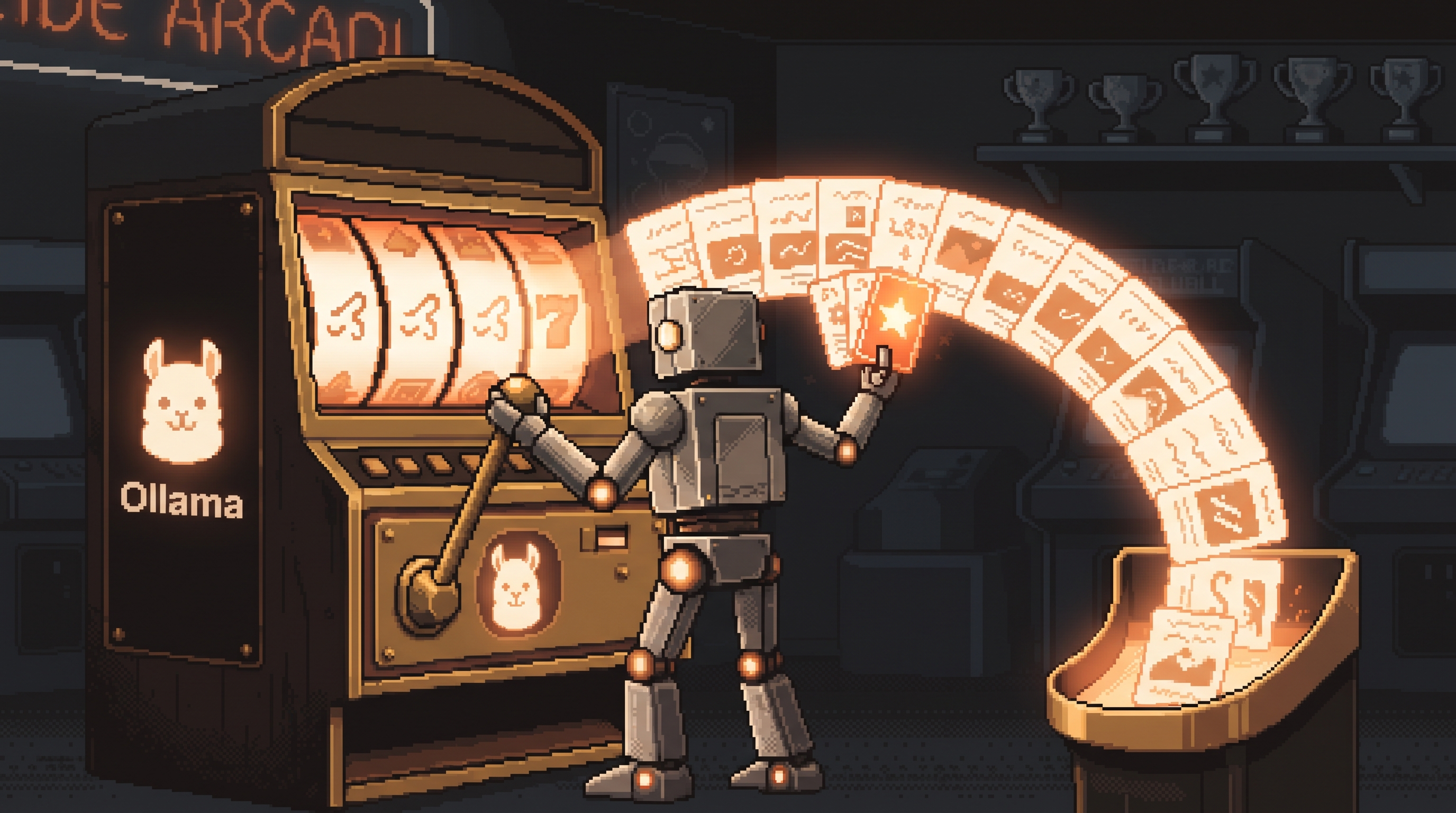
Watch someone use AI for the first time and you'll see the same scene: they type one question, get one answer, judge the whole technology by it, and either shrug or paste it straight into their work. One pull of the lever, one result, one verdict.
That's the interaction pattern almost everyone imports from search engines — and it's precisely backwards for how these systems work. A search engine returns the answer; a language model returns one plausible sample from a distribution. Treating a sampler like a database is why AI feels broken to half the population and magical to the other half. The magical half isn't using better prompts — they've accepted what the machine actually is and reorganized their workflow around it.
The memorable name for that reorganization is the slot machine approach: stop pulling the lever once and hoping for jackpot-perfect; pull it ten times on purpose, then pick the winner. This guide covers the five stages people pass through on the way there (they map eerily onto grief, because that's what letting go of "one perfect answer" is), and the three workflow changes that define Stage 5.
Stop seeking the single perfect prompt and adopt a high-volume "slot machine" workflow: AI is probabilistic — each generation is one sample from millions of possibilities, not the answer. So generate 10–100 variations deliberately (5 caption styles, 20 hooks, 3 framings), select the best, and refine with corrective feedback instead of restarting. Volume plus selection plus iteration beats prompt-perfectionism: good prompts raise your hit rate slightly, but the winners come from generating enough options and using human judgment to pick them.
Why the Machine Behaves Like a Slot Machine
One mechanical fact drives everything else: language models predict the next likely token. Every press of "generate" is a fresh draw from a distribution of plausible continuations — which is why the same prompt gives different answers each time, and why a model can produce brilliance and nonsense on consecutive attempts.
This isn't a defect waiting to be patched by a better prompt; it's the operating characteristic. And it cuts both ways:
- The bad news: no prompt makes every draw a winner. Hallucinations and flat output are possible outcomes of any pull.
- The good news: draws are cheap. If one generation costs seconds, then generating ten costs less time than agonizing over one prompt for ten minutes. The economics reward volume.
The people who "get" AI aren't the ones who found magic words — they're the ones who read the payout table and started pulling deliberately.
The Five Stages of Letting Go
How you react to a bad output reveals your stage. The sequence maps onto grief because that's what it is — mourning the fantasy of the perfect one-shot answer:
Stage 1: Denial
Two flavors, same root. Dismissive denial: it hallucinated once, so it's a glorified search engine — quit forever. Credulous denial: it sounds confident, so paste the first response into the deliverable unverified. Both refuse to see what the machine is: not a fact-checker — a prediction engine. A prediction engine needs a selector. Neither denier provides one.
Stage 2: Anger
The wrong answer triggers frustration — screenshots of weird failures, public complaints about the tool "lying." But the model didn't betray you; it did exactly what its math does, following your instructions literally. Anger treats a sampler like a dishonest person. It's a vending machine that sometimes dispenses something adjacent; yelling at it doesn't change the menu.
Stage 3: Bargaining (the perfect-prompt trap)
Where most people get permanently stuck. The belief: somewhere exists a prompt so precise that every pull pays out. Hours go into crafting elaborate instructions for a task that should take thirty seconds. Good prompts do help — they raise the hit rate from, say, 30% to 50%. But they never reach 100%, because no instruction set can collapse a probability distribution into a certainty. Bargaining optimizes the wrong variable.
Stage 4: Depression
The realization lands: "perfect" takes work. The regenerate button gets worn out, the task that should take minutes takes an hour, and it feels like doing it wrong. Many quietly quit here — concluding AI is more effort than value — when actually they're one mindset shift from the payoff.
Stage 5: Acceptance (the slot machine)
You stop expecting the first result to be the result. You plan for the first pull to be mediocre. You ask for ten, twenty, a hundred variations up front, sit back while the machine samples, and spend your scarce attention on the only job that was ever truly yours: selecting and refining the winner.
| Stages 1–3 (basic) | Stage 5 (slot machine) | |
|---|---|---|
| Goal | the perfect answer, first try | enough options to contain a winner |
| Prompt strategy | hunting magic phrases | clear task, then iterative feedback |
| View of AI | search engine / truth-teller | creative partner, high-volume sampler |
| On a bad output | quit / complain / rewrite prompt | correct it or draw again |
| Final step | paste the first result | select and refine the best version |
The Three Workflow Changes
1. Ask for options, not an answer
Every "give me X" becomes "give me N variations of X across styles":
WEAK:  "Write a caption for this photo."
STRONG: "Give me 5 caption styles for this photo,
        ranging from professional to humorous:
        1 deadpan, 1 pun, 1 earnest, 1 provocative,
        1 one-liner."
Five diverse drafts give you a choice space instead of a single path that might dead-end. And diversity beats repetition — five different angles contain more information than five attempts at the same angle.
2. Correct, don't restart
When a draw is close-but-wrong, deleting the chat and starting over throws away everything that was right. Treat it like an intern who took your brief literally: name the specific defect, keep the good parts, request the surgical fix.
"Paragraph 3 missed the intent — I need the tone
more serious there. Keep everything else. Rewrite
only that section, and ask me one question if
my correction is ambiguous."
This is the numbered-fix-list habit from the blog's other workflows, compressed: feedback on this draw teaches the model what the next draw should fix. Each iteration inherits the accumulated corrections — something a fresh chat never gets.
3. Embrace volume as the workflow
For anything judgment-shaped — hooks, taglines, image concepts, framings, subject lines — volume is the method:
task: social hooks for the newsletter launch
draws: 20 variations, 4 angles x 5 tones
select: pick 3 candidates
refine: corrective feedback on each candidate
outcome: a shortlist no single prompt would produce
The mental reprice: generation is an office-supply cost, not an event. Twenty hooks cost pennies and thirty seconds; the alternative — crafting one "perfect" prompt and hoping — costs your evening and delivers one option. Selection time is human; generation time is the machine's. Spend each on its comparative advantage.
The Local Slot Machine
One upgrade worth naming: volume economics improve further when the machine is yours. A local model (Ollama) pulls the lever at zero marginal cost — no per-token anxiety, no meter running while you explore 50 framings. The pattern this blog keeps returning to applies perfectly here: cloud models when you need their quality for the finalist round; the local slot machine for the cheap, high-volume exploration where nobody's counting pulls. Sensitive drafts also stay home while you're at it.
Where the Slot Machine Stops
Honest boundaries. Volume suits generative tasks where variation is native and selection is cheap. It doesn't suit deterministic work — the correct answer to "what's 347 × 89" doesn't improve with twenty draws — and selection effort grows with output length: 20 taglines is a scan; 20 whitepapers is a reading assignment. Match the draw count to the size of what you're selecting. And the winner still needs your verification — a confident, fluent draw that's factually wrong is the slot machine's most dangerous payout.
Frequently Asked Questions
Why does AI give different answers to the same prompt?
Because generation is probabilistic — the model predicts the next likely token, drawing from a wide distribution of possibilities each time. It isn't retrieving one true answer; every press of generate creates a unique variation. That variance is a feature to exploit, not a bug to fix.
Are long, detailed prompts actually worth writing?
Yes — strong context raises your hit rate and keeps draws on-target. But it raises the rate, not the ceiling: even the best prompt yields some misses, so iteration and selection remain mandatory. Write clear briefs, then plan to pick winners.
Doesn't generating many versions waste money and time?
Reprice it: generation is cheap and getting cheaper, while your crafting time is the scarce resource. Twenty variations cost pennies and seconds; one agonized prompt costs your evening and produces one option. You're trading machine time (abundant) for human time (scarce) — the correct trade.
When is the slot-machine approach wrong?
Deterministic tasks — math, lookups, anything with a single correct output — gain nothing from multiple draws. And selection cost scales with length: batch-generate short artifacts (hooks, tags, concepts), not long ones. Volume is for generative work where variation is native.
Wrap-Up
The half of the world that thinks AI is overhyped and the half that thinks it's magic are describing the same machine — one just learned its payout table. Accept the five stages, stop bargaining for the perfect prompt, and reorganize around what the machine actually does: ask for options in bulk, correct the near-misses instead of restarting, and select winners with the judgment only you have. The slot machine was never rigged — you were just pulling the lever once.
Related posts
Hire the Playbook: Claude Skills as Guided, Step-by-Step Workflows
Abandoned projects aren't waiting on motivation — they're waiting on structure. A skill file turns Claude from answer-dispenser into guide: plan decomposed, one step visible at a time, ELI5 on demand.
Stuck Between Two Options? Break Decision Paralysis Before the Deadline
A tied pro/con list means the list is out of answers. Break the binary, audit which beliefs you can verify before Friday, pre-live both futures — then hunt the one missing fact.
Map It First: Design Workflows Before You Automate Them
Automating an unmapped process just repeats the mess faster. Document reality, name an owner for every output, bound automation by risk — then hand the runbook to people or AI agents.