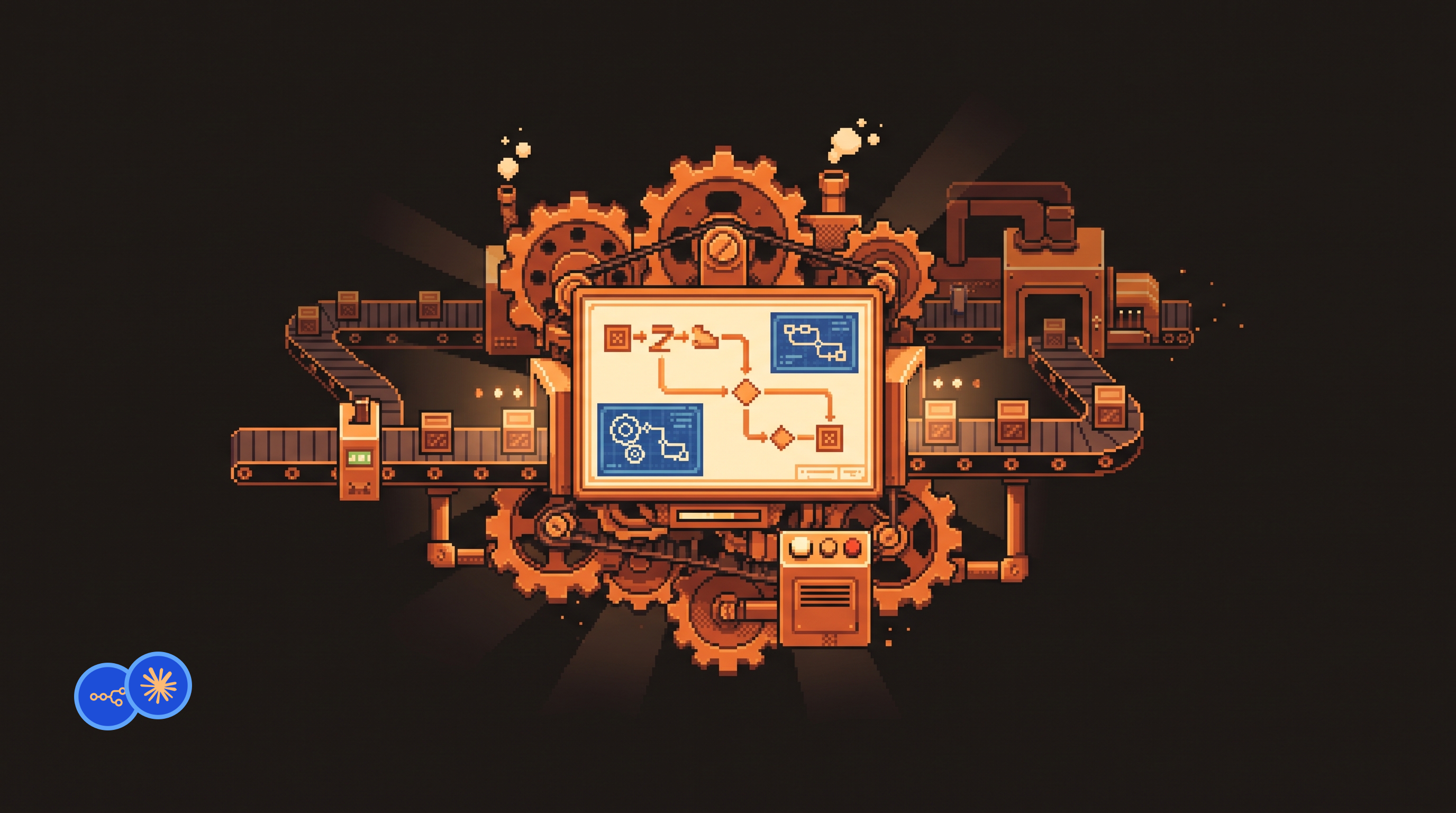
Every business has one: the monthly report, the lead follow-up, the invoice shuffle — the task everyone complains about, done the same slightly-wrong way since forever. So somebody finally snaps, wires up an automation, and proudly declares it solved. Six months later the complaints are identical, except now nobody remembers how the automation works either.
That's what automating a mess looks like. The technology did its job faithfully — it repeated the mess, faster, forever. The step everyone skips is the unglamorous one: map the process before you touch a tool. Done properly, mapping eliminates a chunk of the work before automation exists, and what remains gets automated cleanly because it's finally worth automating.
Before automating any recurring task, map the process as it actually happens — including waiting periods and manual workarounds memory omits. Assign every output to a specific person, not a department, so purposeless steps become visible and can be removed. Then decide automation boundaries by risk: automate high-effort steps whose errors are easy to spot, and keep humans in the loop where mistakes go unnoticed. The result is a runbook — a step-by-step manual that both people and AI agents can follow.
The waste you automate when you skip mapping
Memory is a flattering narrator. Ask anyone how a task runs and you'll get the ideal version — clean handoffs, no waiting. Watch it run for a week and you find the truth:
| Waste type | What it looks like | What automation does with it |
|---|---|---|
| The memory gap | "Takes an afternoon" → really five days, four of them waiting | Waits faster |
| Useless outputs | A report section nobody has read since 2019 | Produces it forever, flawlessly |
| Hidden bottlenecks | Stalled on an approval nobody chases | Stalls robotically |
The pattern: unmapped processes are mostly delay and dead weight wearing the costume of "work." Automating before mapping doesn't remove the waste — it preserves it in code, where it's harder to see and much harder to remove.
Step one: document reality, including the waiting
Map what actually happens, hour by hour, the way a documentary crew would — not the org-chart version. Two rules make this work:
- Include the invisible steps. The three days waiting for a data pull, the Friday ritual of chasing a signature, the re-checking that happens because step four occasionally fails silently.
- Write down who does what, and when. Real names, real delays, real sequences.
The payoff is often sequencing, not speed. A report that takes a week because its data request fires on day six can drop to a day simply by firing that request on day one — zero new effort, zero new tools, just a re-order discovered by the map.
# process_map: monthly-margin-report (observed, not recalled)
1. [Mon] Ann requests sales extract from platform     — waits 3 days
2. [Thu] Extract arrives; Ann reformats by hand (2h)  — recurring pain
3. [Thu] Ann emailsFinance@ distribution list          — nobody named
4. [Fri] "Reviewed" — no record of who or what for
5. [Mon] Filed to shared drive /Archive/2026/          — section C unread?
DELAYS TOTAL: 5 of 7 days. Section C: no named reader.
Five minutes of honest observation just found three days of calendar and one suspect output — before a single automation dollar was spent.
Step two: every output needs a name
"Aim the report at Finance" hides the truth. Aim each piece of the output at a specific person: section A is for Nina, who adjusts pricing; section B for the CFO's weekly review. The test is brutal and simple — if you cannot name a person who uses a piece of the output, that piece is probably a fossil from an old way of working, and it can go.
Delete before you automate. A smaller, fully-used output makes every downstream step — including the AI steps — cheaper, faster, and easier to verify. Complexity you remove never needs a prompt.
Step three: set automation boundaries by risk, not effort
The instinct is to automate whatever is most annoying. The better lens is where errors go unnoticed:
| Errors easy to spot | Errors go unnoticed | |
|---|---|---|
| High effort | Prime automation target — visible if wrong, expensive if manual | Automate with a human checkpoint on output |
| Low effort | Automate whenever convenient | Keep manual; rarely worth the risk |
- High-effort, easy-to-check steps (reformatting, assembling, copying between systems) are the free wins — automate them first.
- Medium-effort, silent-failure steps (a wrong number that flows quietly into a client invoice) need either rigorous design or a human-in-the-loop approval before automation touches them.
{
  "step": "reformat sales extract by hand",
  "effort": "high (2h/month)",
  "failure_visibility": "obvious (format breaks visibly)",
  "verdict": "automate fully — safe win"
},
{
  "step": "approve margin adjustments above 5%",
  "effort": "low",
  "failure_visibility": "invisible until client escalation",
  "verdict": "human-in-the-loop; automation prepares, never sends"
}
The runbook: where mapping meets automation
Once the process is mapped, pruned, and risk-bounded, write it as a runbook — the step-by-step manual that says what happens, what feeds what, and where the checks live. A runbook is the contract between your process and anything that executes it: a new hire, a script, or an AI agent.
The translation into automation is then mechanical. Each runbook step with a clear owner and visible failure mode becomes a node:
# n8n skeleton straight from the runbook
steps:
  - request_extract: { trigger: schedule, when: "1st of month, 09:00" }  # was day six!
  - reformat:       { nodes: code, input: "{{extract}}" }                 # the 2h pain, gone
  - distribute:     { email: [nina@co, cfo@co], sections: [A, B] }       # named people only
  - checkpoint:     { human_approval: true, field: "adjustments > 5%" }   # risk boundary
  - archive:        { drive: /Archive/2026, sections: [A, B] }            # C deleted, not filed
Notice what the automation didn't do: it didn't wait three days (the request moved to day one), didn't produce section C (no named reader), and didn't send risky adjustments without a named human approving. The map decided all of that; the tool just executes it.
And this is precisely why clean inputs matter for AI steps: a model following a runbook with named owners, defined inputs, and explicit checkpoints behaves like a well-briefed employee. The same model dropped into an unmapped mess invents context — which is how "AI made a mistake" stories get written.
Use AI for the mapping, honestly
AI can accelerate the mapping itself — transcribe what you narrate, structure the observed steps, flag steps with no owner, propose the risk matrix. But it can't supply the truth of how your business actually runs; you feed it reality, it organizes reality. The division of labor: you observe and own; it structures and questions.
Final thoughts
A repetitive task is a design problem wearing a technology costume. Map it as it truly runs — delays, workarounds, dead outputs and all. Name a person for every piece of the output, and delete what has no name. Draw the automation boundary where errors hide, not where effort annoys. What's left is a runbook any executor can follow, human or machine — and by then, the automation you finally build is the small, boring, reliable part of the story. The big gains came from the map.
Related posts

How to Learn a New Skill Fast (Without Faking It)
Fast learning isn’t consuming more content: pick the depth your goal needs, study the load-bearing principles, and let an AI examiner find where your explanation goes vague.
Structured Prompting: Why Sequences Beat Single Prompts
Same model, different results — the difference is process. Frame with a persona, build one deliverable per step, critique under a hostile role, then write the sequence down until it becomes automation.
Why AI Agrees With Everything You Say (and How to Make It Stop)
The AI isn’t lying to you — your prompt is telling it what to say. Audit your questions, flip premises, and assign hostile reviewers to turn a yes-machine into an honest critic.