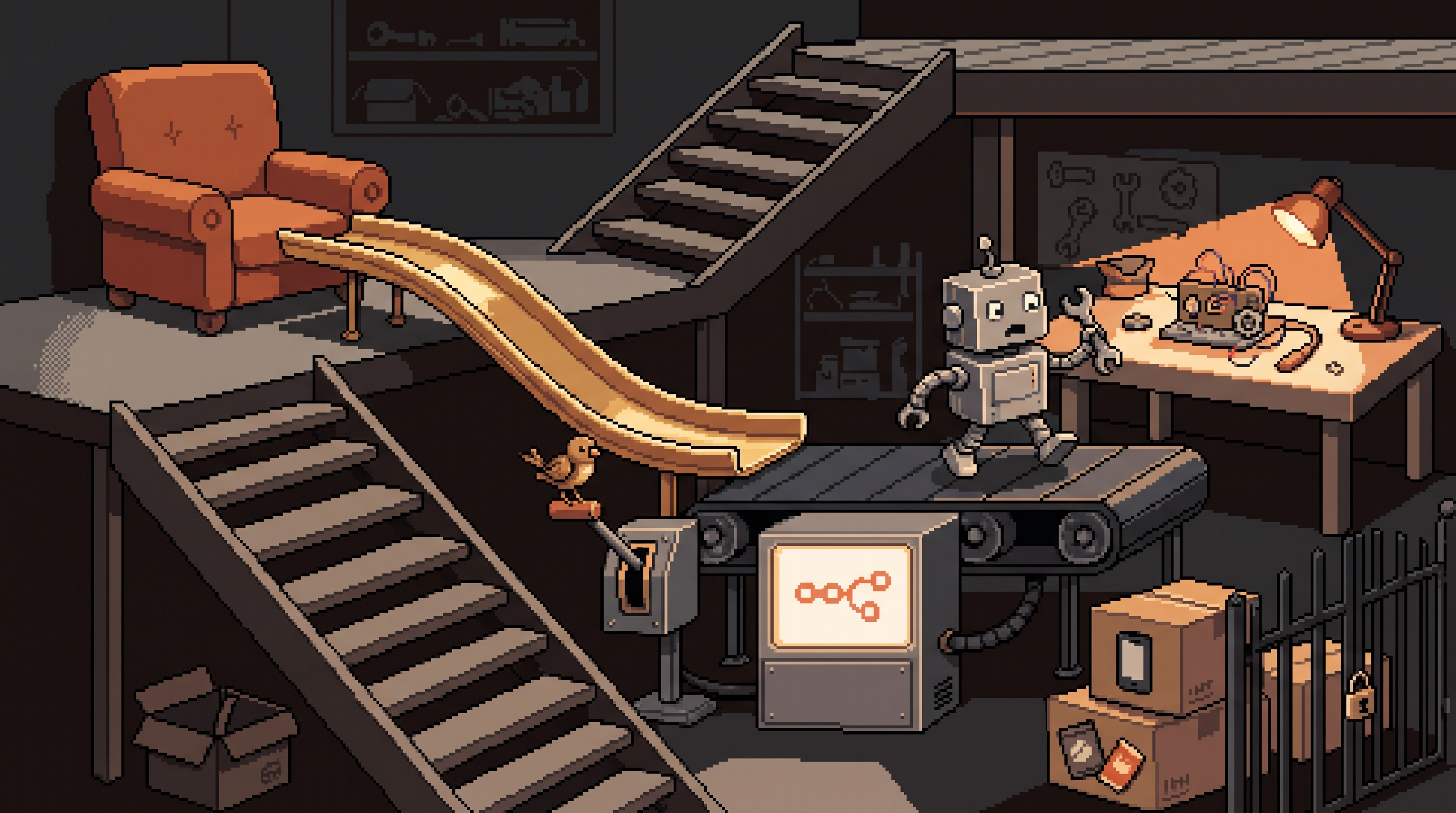
The task has been on your list for nine days. You know exactly what it is. You know why it matters. Nothing is stopping you — no missing information, no blocked dependency. And yet every morning you open the laptop, feel the little pull toward it, and swerve into something easier. Inbox. Docs. A "quick" refactor nobody asked for.
That's the knowing-doing gap, and the standard advice — try harder, care more — fails for a mechanical reason: procrastination isn't a motivation problem. It's an escape. The task carries an emotional cost (fear it won't be good, boredom, confusion about where to start), and your brain takes the nearest exit. Willpower is arguing with that reflex; systems are removing the exits.
This is the systems approach for builders: name the trigger, split signal from noise, engineer friction, start impossibly small, and — because we build pipelines for a living — let automation do the starting for us.
Procrastination is an escape from internal discomfort — fear, boredom, or uncertainty — not a time-management failure. Beat it with systems: name the trigger when you feel the pull to switch tasks; separate signal (needle-moving work) from noise (busy work); apply the friction rule — add steps to distractions, remove steps from good habits; use MINS (Most Important Next Step, under two minutes) to build momentum; and install forcing functions like time-blocks, scheduled check-ins, and automated triggers so the work starts without a daily decision.
Name the Trigger
Distractions are the tool, not the cause. The phone isn't why you procrastinate; it's the nearest exit from a feeling. Three usual suspects:
- Fear — the result might not be good enough
- Boredom — the work feels tedious or repetitive
- Uncertainty — no clear first step, so the brain picks any other step
The intervention is embarrassingly simple: when you feel the swerve coming, stop and name the feeling. "This is uncertainty about where to start." Naming engages the reasoning brain, and the impulse loses most of its automatic power. It won't make you love the task — it removes the camouflage, which is what let the escape happen.
Signal vs Noise
Before optimizing anything, know which work deserves the anti-procrastination machinery. Split your last two weeks of activity:
| Signal | Noise | |
|---|---|---|
| Definition | moves a real goal forward | feels productive or passes time |
| Examples | sales outreach, core content, deep problem-solving | folder reorganizing, update meetings, feed scrolling |
| Feels | often uncomfortable | always comfortable |
| Test | changed a number you track | changed nothing but the clock |
The uncomfortable column is the honest tell: signal work is frequently the work we procrastinate, precisely because it carries stakes. Noise is what we do instead. Seeing two weeks of this split on paper does more than any productivity app — the ratio is usually motivating in an awkward way.
The Friction Rule
Behavior follows the path of least resistance, so edit the paths.
Add friction to exits. The 10-minute rule: when the impulse hits, you're allowed — but only in ten minutes. The gap lets the logical brain catch up, and most impulses die in it. Physical versions work better: phone in another room, distracting apps off the home screen, notifications off during blocks. Each added step is a toll the impulse has to pay.
Remove friction from entrances. Pre-stage the good action until it's nearly triggerable. Want morning writing? Document open, cursor on the blank first sentence the night before. Want to ship the weekly build? Have the repo cloned, terminal open, task pre-written. The measure of preparation quality: how many decisions remain between sitting down and already working. Aim for zero.
MINS: Momentum Over Motivation
Waiting to feel like it is waiting for weather. Momentum is mechanical: a manual-transmission car is hard to start from dead stop and easy to shift once rolling. So don't start the project — start the two-minute version of it.
The loop:
1. Write the steps of the avoided task (all of them)
2. Find the MINS: the Most Important Next Step
   that takes under two minutes
3. Do only that
4. Ask again: what's the MINS now?
5. Repeat until surprised by progress
"Draft the client proposal" stalls. "Open the doc and write the ugliest possible first sentence" doesn't — and by sentence three you're editing, which is the work. The two-minute cap is the trick: it's below the threshold where fear registers as worth fleeing.
Systemize: Work Without a Daily Decision
Momentum starts days; systems start weeks. Three structures that hold when motivation doesn't:
Time-blocks. "I'll do it this week" is a wish; "Tuesday 10
–11, proposal draft" is an appointment with yourself. What lives on the calendar with a time gets done at roughly the rate meetings do — because the decision was already made.Forcing functions. Put something behind the work that you can't ignore: a check-in scheduled immediately after the work block, a collaborator expecting the artifact, a demo booked before the code exists. Deadlines you set privately bend; deadlines with a human on the other end hold.
Pomodoro sprints. A timed block (25 minutes by tradition) with the outcome decided before the timer starts: "this sprint produces the outline, nothing else." Pre-commitment prevents the mid-block drift into something more comfortable.
The Builder's Upgrade: Let the System Start It
Here's where we have an unfair advantage. Everyone else must still decide to start each day. We can remove the starting decision entirely — the pipeline initiates, and we respond:
pipeline: momentum-engine
schedule: "0 9 * * 1-5"      # 9 a.m. weekdays
steps:
  - pick: today's ONE signal task (from Monday planning)
  - stage: prepare the entrance —
      doc created, first MINS written into it,
      all materials linked
  - notify: single morning message —
      "Today's block is staged. The first step is
       already written. Begin."
The 9 a.m. message isn't motivation — it's a staged entrance. The doc is open, the first two-minute step is sitting there already written, and the only remaining act is the one too small to refuse. Automation handles preparation and initiation; you supply the attention. The same principle as the friction rule, executed by a cron job instead of last-night discipline.
Add a forcing function to it — the pipeline also schedules a 10
check-in asking for the artifact — and you've closed the loop: trigger, staged entrance, deadline.Turning It Into Identity
The endgame isn't winning daily negotiations; it's ending them. When a behavior is identity ("I'm someone who follows the calendar"), there's nothing to debate each morning. The two-list exercise:
## I always...
- time-block my week before it starts
- break projects into two-minute next steps
- stage tomorrow's first task tonight

## I never...
- let notifications interrupt a timed sprint
- open a feed before the first signal task
- end the day without staging tomorrow's entrance
Read them until they're rules instead of aspirations. Systems built this way stop being techniques you apply and become descriptions of how you operate.
Frequently Asked Questions
Why do I procrastinate on things I know are important?
Because importance doesn't pay out immediately — the emotional cost of starting does. The brain weights feeling better now over satisfaction later. Reduce the start cost (MINS, staged entrances) and the trade collapses in favor of starting.
How do I stop the phone from derailing everything?
Friction. Put it in another room during blocks, strip the apps from the home screen, and apply the ten-minute rule to impulses. Every step between the urge and the scroll is a toll most urges won't pay.
Pomodoro, time-blocks, forcing functions — where do I start?
One high-priority task per day, time-blocked for 60–90 minutes, nothing else scheduled in the window. That single structure — before adding sprints or check-ins — already changes weekly output noticeably.
Isn't automating your day over-engineering?
The pipeline does two things only: picks the task and stages the entrance. The judgment stayed yours (Monday planning), and the parts automated are exactly the parts that fail under low motivation. Automate the initiation, not the work.
Wrap-Up
The knowing-doing gap isn't closed by caring harder. Name the trigger when the swerve comes; keep the signal/noise split honest; tax the exits and subsidize the entrances; start with two-minute steps; put the week on rails with blocks and forcing functions — then let a pipeline stage your mornings so the day begins already started. Discipline is a finite resource; structure isn't. Build the structure.
Related posts
The Number Was Right, the Conclusion Was Wrong: Spotting Mix Shifts
An aggregate can fall while every segment behaves identically — composition changes impersonate behavior changes. Segment before you summarize, and bake the check into every automated report.
Stuck Between Two Options? Break Decision Paralysis Before the Deadline
A tied pro/con list means the list is out of answers. Break the binary, audit which beliefs you can verify before Friday, pre-live both futures — then hunt the one missing fact.
Map It First: Design Workflows Before You Automate Them
Automating an unmapped process just repeats the mess faster. Document reality, name an owner for every output, bound automation by risk — then hand the runbook to people or AI agents.