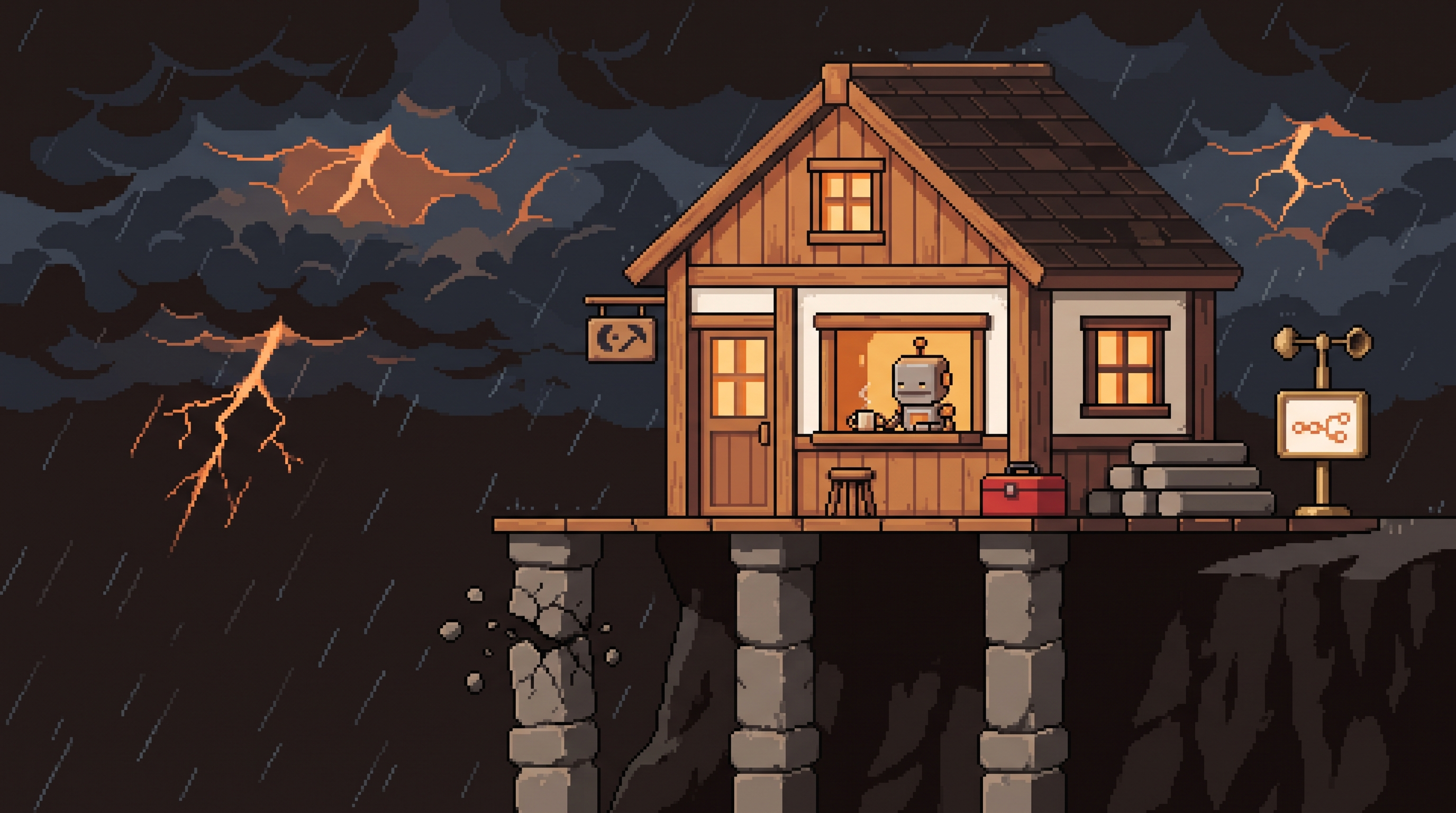
A new model drops. Within a week, three people in your field announce their whole business just got easier — and one announces it just got pointless. The difference is almost never talent or speed. It's structure: one business had a single point of failure, and the other didn't.
Here's the uncomfortable pattern: when a solo consultancy gets wiped out by a technology shift, the postmortem always finds the same thing. Every lead came from one platform. Every process lived in one head. Every dollar came from one service that the new technology does for free.
You can't predict which technology shifts next, and neither can I. The durable move isn't a better prediction — it's building a business that doesn't need the prediction to be right. This post shows how: find the one thing that must stay true for your business to survive, then make sure it isn't the only thing.
A business becomes fragile when survival depends on a single point of failure — one lead channel, one product, one client, one person's knowledge staying unchanged. Instead of predicting how AI or any technology will hit your industry, audit for these dependencies and add a second independent option before you need it: a second lead source, a documented process, a second revenue line. Resilience trades the maximum upside of a perfectly predicted bet for a high floor that survives any single shift.
Why Prediction Is the Wrong Game
When a big shift like AI arrives, owners respond in two familiar ways:
- The defensive move. Protect what exists, wait for the dust to settle. Risk: you're safe but stagnant, and the dust settles on you.
- The all-in move. Pivot everything toward the predicted future. Risk: spectacular if right, fatal if wrong — and you only get to be right by luck.
Both are bets on a prediction. The goal is a third option: a business that remains viable across several different futures, so no single shift — technological or otherwise — can take the whole thing down. You're not trying to win the forecast; you're trying to stay in the game regardless of the weather.
The Audit: Find What Must Stay True
Run one honest exercise. For each pillar of your business, ask: "If this stopped working tomorrow — platform banned me, client left, tool died — would the business survive?"
The audit prompt, ready to run against your own answers:
I will describe my business: lead sources, revenue lines,
key processes, and who knows them.
For each element, assess:
1. SINGLE POINT OF FAILURE? (yes/no + what breaks it)
2. BLAST RADIUS if it failed (survive / wounded / dead)
3. CHEAPEST second option to remove the dependency
Rank by blast radius, worst first. Be blunt; do not
reassure me. DESCRIPTION: <paste>
The output you want looks like this:
{
  "audit_date": "2026-08-26",
  "fragile": [
    {"thing": "80% of leads from one Facebook group",
     "blast_radius": "dead in ~3 months",
     "second_option": "weekly SEO article + newsletter"},
    {"thing": "onboarding process lives only in my head",
     "blast_radius": "wounded if I'm sick for 2 weeks",
     "second_option": "record walkthrough, write SOP"}
  ],
  "solid": [
    {"thing": "three revenue lines across services"}
  ]
}
That list, ranked by blast radius, is your resilience roadmap. Work it top down.
The Four Classic Single Points of Failure
One lead channel
If one platform delivers most of your customers, its algorithm update is your revenue update. The resilient move: build a second, independent channel before you need it — one that doesn't share the same failure mode. A Facebook group and Instagram ads fail together (same platform); a Facebook group and an SEO newsletter don't. A useful rule of thumb: the second channel should feel annoyingly slow to build. Slow channels are usually the durable ones.
One client or employer
More than half your revenue from one logo is a job with extra steps. The fix isn't necessarily ten more clients — it's a floor: enough spread that losing the biggest one is a bad quarter, not an ending.
One person's head
If the "how" of the business — the client setup ritual, the deployment checklist, the pricing logic — exists only in one skull (usually yours), the business has a single point of failure that catches colds. Documentation is the second option, and it's cheap:
sop_backlog:
  week_1: client onboarding, end to end
  week_2: the delivery workflow, step by step
  week_3: pricing + how you qualify leads
  rule: record yourself doing it once, transcribe locally,
        clean up into a checklist
A local transcription model makes this painless and keeps client details off third-party servers — record, whisper it, tidy the checklist on a Sunday.
One product
One service, one price, one delivery. When technology eats it — and eventually something eats some of it — there's nothing behind it. The second line doesn't need to be big; it needs a different failure mode. The classic ladder for technical operators: done-for-you service → templated productized version → teaching what you know. Each layer breaks differently.
Resilience for the Automation-Heavy Business
There's a modern twist worth naming: if you build automations, the automations themselves become dependencies. An n8n pipeline that taps a third-party API inherits that API's outage schedule; a workflow glued to one model provider inherits its price changes. Same medicine, applied inward:
| Dependency | Failure mode | Second option |
|---|---|---|
| One platform for all leads | algorithm/policy change | SEO + owned email list |
| One big client | their budget cycle | floor of smaller retainers |
| Process in one head | illness, turnover | recorded SOPs, checklists |
| One automation on one API | outage, price hike | fallback step in the flow |
| One model provider | rate limits, pricing | local fallback via Ollama |
That last row is why local-first matters strategically, not just philosophically: a local model is the one inference option whose pricing and availability you control. It doesn't need to be your best model — it needs to be the one that can't be taken away from you.
Sustainability Beats Maximum Upside
Here's the honest trade: diversification caps your peak. The all-in business that predicts correctly grows faster than the spread one. Fine. Over ten years of unpredictable shifts, the resilient business compounds because it never resets to zero. You're choosing a higher floor over a higher ceiling — and the floor is what keeps you in the game long enough for any ceiling to matter.
Practical cadence:
- Quarterly — re-run the audit; fragility creeps back as you grow
- Immediately — anything with blast radius "dead"
- Within a quarter — anything "wounded"
Frequently Asked Questions
Is AI the reason my business is at risk?
AI is the spotlight, not the crack. It accelerates change and exposes dependencies that were always there — one lead channel, one client, one product. If a technology shift could end you, the ending was structurally possible before the technology arrived.
How do I start making my business resilient today?
Run the audit and find your biggest dependency: "If X stopped tomorrow, would I survive?" If no, build the second option for that one thing before touching anything else. One removed single point of failure per quarter is a fast pace.
Doesn't diversifying mean giving up growth?
It caps the peak of any single bet, yes — the perfectly-predicted pivot outgrows the spread business. But it raises the floor, and the floor is what survives the shifts you didn't predict. Over a decade, not resetting to zero beats any single boom.
How much redundancy is enough?
Enough that the worst item on your audit says "wounded," not "dead." Beyond that, more redundancy is distraction. The goal is surviving any single failure, not building a fortress against every conceivable one.
Wrap-Up
Stop asking what the next technology will do to your business — nobody knows. Ask instead: what one thing must stay true for it to survive? Find it, then make it not-one: a second lead channel with a different failure mode, a floor under your biggest client, your processes out of your head, a second revenue line, a local fallback for your critical model calls. Resilience isn't predicting the weather. It's building so no single storm ends you.
Related posts
Four Gates: Validating a Business Idea With AI Before You Build
"Is this a good idea?" gets you a cheerleader. Run four kill-oriented gates against live market data instead — fail one, stop.
Sell the Boring Thing: Turning Automation Expertise Into Paid Offers
The automation work that feels routine to you is an emergency to someone else. Package it as a fixed-price result and sell it.
The AI Business Roadmap: Earn, Build, Expand, Commit
Why sequence beats the big idea: earn skills through consulting, build a brand from real cases, expand into scalable offers, then commit to one — plus the deployment-gap goldmine.