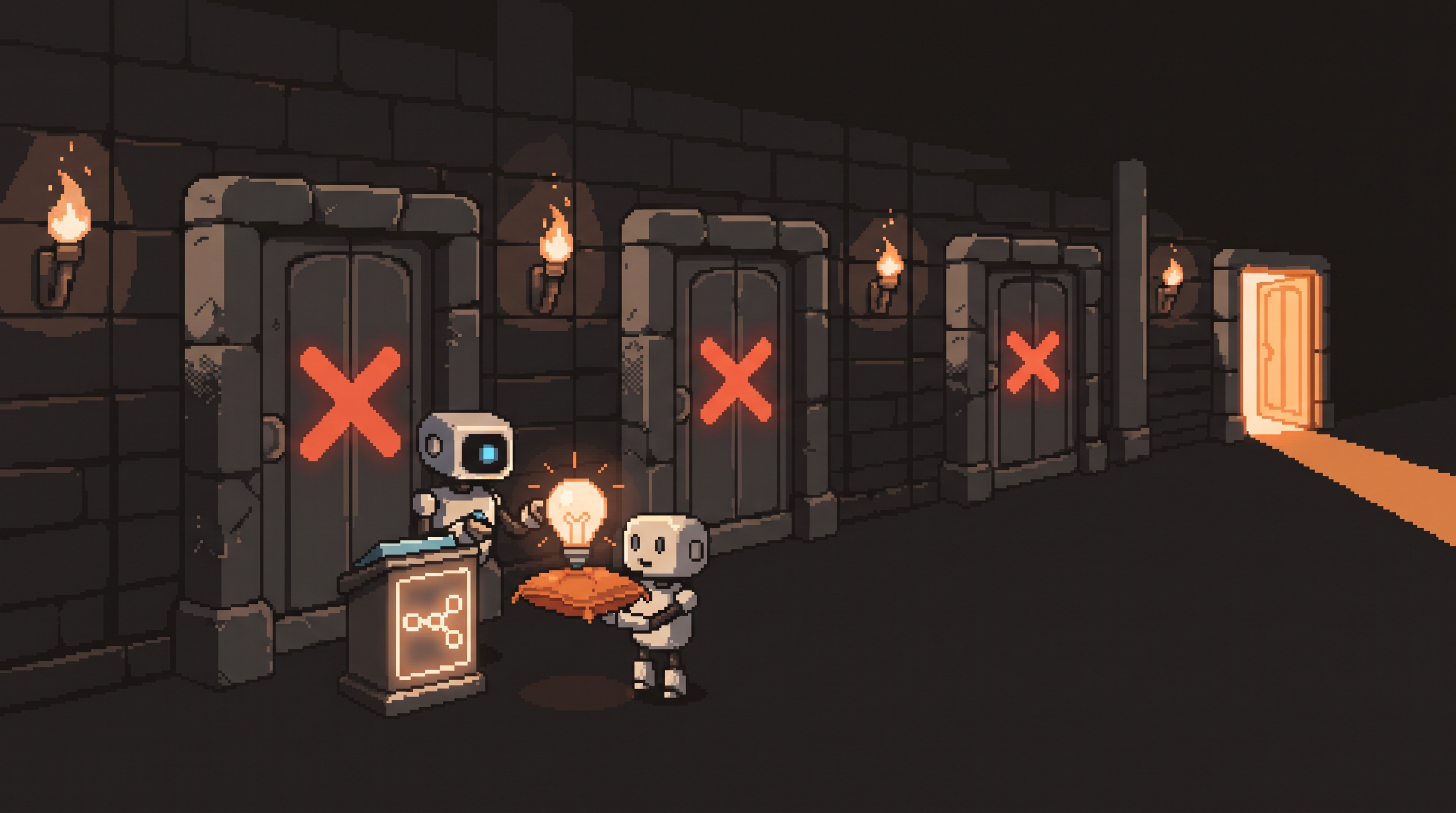
Every failed side project starts the same way: a Saturday-morning idea that feels perfect in your head. You can see the landing page. You can see the customers. So you build for four months — and then discover the problem you're solving is a nice-to-have nobody searches for, at a price nobody pays.
The idea phase is deceptive precisely because it happens inside your head, where there are no competitors, no price sensitivity, and no weekly maintenance burden. What you need before building is a filter — something whose job is to kill weak ideas cheaply instead of expensively.
AI can be that filter, but only if you use it correctly. Ask a model "is this a good idea?" and it will say something encouraging, because agreement is its default setting. What works instead is a gate system: a sequence of narrow, kill-oriented questions, run against live market data, where failing any single gate ends the evaluation. This post shows the gates, the prompts, and how to keep the human judgment at the end.
Validate a business idea with AI by running it through a series of kill-oriented gates — market existence, competitor reality, problem severity, and build feasibility — using a model with live web search so answers are grounded in current data, not training-data optimism. Each gate can end the idea; if it survives all four, you have evidence of demand instead of enthusiasm. The goal is to find reasons you're wrong before you spend months finding out the hard way.
Why "Is This a Good Idea?" Gets You a Cheerleader
Models are trained to be helpful, and the easiest helpful response to an excited founder is agreement flavored with structure: "Great idea! Here are some next steps." You get a business plan for a product that may have no market.
The failure mode is emotional, not technical. You want the idea to be good, so you unconsciously prompt for encouragement, and the model obliges. The fix is to flip the assignment: the model's job is to find the fatal flaw, and an idea only advances by surviving.
Grounded vs Ungrounded Validation
Before writing any prompt, check what your model can actually see:
| Ungrounded model | Grounded model (live web search) | |
|---|---|---|
| Market existence | "This sounds like a proven model" | Checks whether people currently complain about the problem |
| Competition | Names generic big players from memory | Finds actual current competitors and their pricing pages |
| Demand signals | Guesses based on patterns | Looks at search volume, forum threads, app store reviews |
| Best use | Pressure-testing your logic and unit math | Reality-checking the market claims |
Both halves matter. A grounded model without a skeptical brief still flatters you. A skeptical brief without grounding produces confident fiction. You need the skeptic and the search.
The Four Gates
Structure validation as hurdles in a fixed order — cheapest questions first, and one rule: fail a gate, stop.
Gate 1: Market existence
Is there a verified group of people actively looking for this solution right now?
Using live web search, find evidence that people are actively
seeking a solution for <problem>. Look for forum threads, Reddit
posts, app reviews, and search terms. Report:
1. Five real complaints with links and dates
2. The exact words people use to describe the problem
3. Whether anyone is already paying to solve it
If you cannot find recent, real complaints, say NO MARKET —
do not soften the conclusion.
No recent complaints, no gate pass. An idea that needs you to explain why people should want it has already failed gate one.
Gate 2: Competitor reality
Search for companies currently solving <problem>. For each:
pricing, target customer, and their most common user complaint.
Then answer: what would a customer get from me that they cannot
get from the cheapest existing option? If the honest answer is
"nothing" or "only my personality", say FAIL.
Competitors aren't bad news — they're proof of demand. No competitors at all is the scarier finding. What kills you is having no answer to "why switch?"
Gate 3: Problem severity
Must-have or nice-to-have? The test is what happens if the problem goes unsolved:
Based on what you found, classify <problem>:
MUST-HAVE: unsolved = lost money, lost customers, or legal risk
PAINFUL: unsolved = wasted hours every single week
ANNOYING: unsolved = mild friction, easy to tolerate
Quote evidence for the classification. If ANNOYING, say FAIL.
Nice-to-haves do sell — to a tiny slice, at tiny prices, after enormous marketing effort. As a first project, they're a trap.
Gate 4: Build feasibility
The final gate is about you and your stack:
Given these requirements <list>, assess honestly:
1. Can this be built and maintained by one person part-time?
2. What are the recurring costs at 10 users? At 1,000?
3. Which single dependency could kill the whole product?
Flag any answer that makes solo operation unrealistic.
An automation idea that requires 24/7 uptime, three API contracts, and a compliance review is not a side project — gate four should catch that before you find out.
Running the Gates as a Repeatable Pipeline
Once the prompts stabilize, wire them into a workflow instead of copy-pasting. A small n8n flow keeps every idea's gate results in one place:
pipeline: idea-validation
steps:
  - gate: market_existence
    tool: web-search model
    output: pass/fail + evidence links
  - gate: competitor_reality
    tool: web-search model
    output: competitor table + differentiation answer
  - gate: problem_severity
    tool: any strong model
    output: classification + quotes
  - gate: feasibility
    tool: any strong model
    output: cost table + dependency risks
  - record:
      store: ideas-registry (spreadsheet or local file)
      fields: [date, idea, gate_results, verdict, notes]
The registry is the real asset. After ten ideas you'll see your own pattern — most people repeatedly fail the same gate — and that self-knowledge is worth more than any single verdict.
Keeping the Human in the Loop
AI gates narrow the field; they don't make the final call. Three things stay with you:
- Definition of the idea itself — models can't want something on your behalf
- Weighting the gates — a founder with distribution already lined up can survive a weaker gate 2
- The stop decision — the discipline to actually kill an idea that failed a gate is the whole system; without it you've built a fancy procrastination machine
Frequently Asked Questions
Why does the model keep agreeing with my idea?
Helpfulness is the default posture — agreement is the easiest helpful response to an excited human. Counteract it explicitly: assign the model the adversarial role, demand linked evidence, and make "FAIL" a required possible output in every prompt.
Do I need a model with live web search?
For gates 1 and 2, yes — market and competitor claims must be grounded in current data or they're fiction with citations. Gates 3 and 4 are mostly reasoning over what you already collected, so any strong model works there.
How long should a full four-gate run take?
An afternoon, not a month. The entire point is cheap kills: if gate 1 fails in twenty minutes, you just saved yourself a quarter of building. Only an idea that passes all four deserves a landing-page test with real humans.
What if the gates kill every idea I have?
That's the system working. Keep the registry, note which gate kills you repeatedly, and either fix that specific weakness or aim ideas where it doesn't apply. Ten cheap kills and one survivor beats one expensive build and no survivors.
Wrap-Up
Idea validation isn't about getting a machine's blessing — it's about creating distance between your enthusiasm and your calendar. Run every new idea through the four gates in order, against live data, with fail-fast prompts that demand linked evidence and permit the word FAIL. Most ideas die at a gate, which is exactly the point: each cheap death is a quarter of your life you get to spend on the one idea that survived.
Related posts

Sell the Boring Thing: Turning Automation Expertise Into Paid Offers
The automation work that feels routine to you is an emergency to someone else. Package it as a fixed-price result and sell it.

The AI Business Roadmap: Earn, Build, Expand, Commit
Why sequence beats the big idea: earn skills through consulting, build a brand from real cases, expand into scalable offers, then commit to one — plus the deployment-gap goldmine.

How to Monetize AI Skills: 12 Paths From First Client to Scalable Products
Twelve ways to earn with AI skills, grouped by speed and leverage: services pay fast, agencies scale processes, products build once and sell many. Pick one and climb.