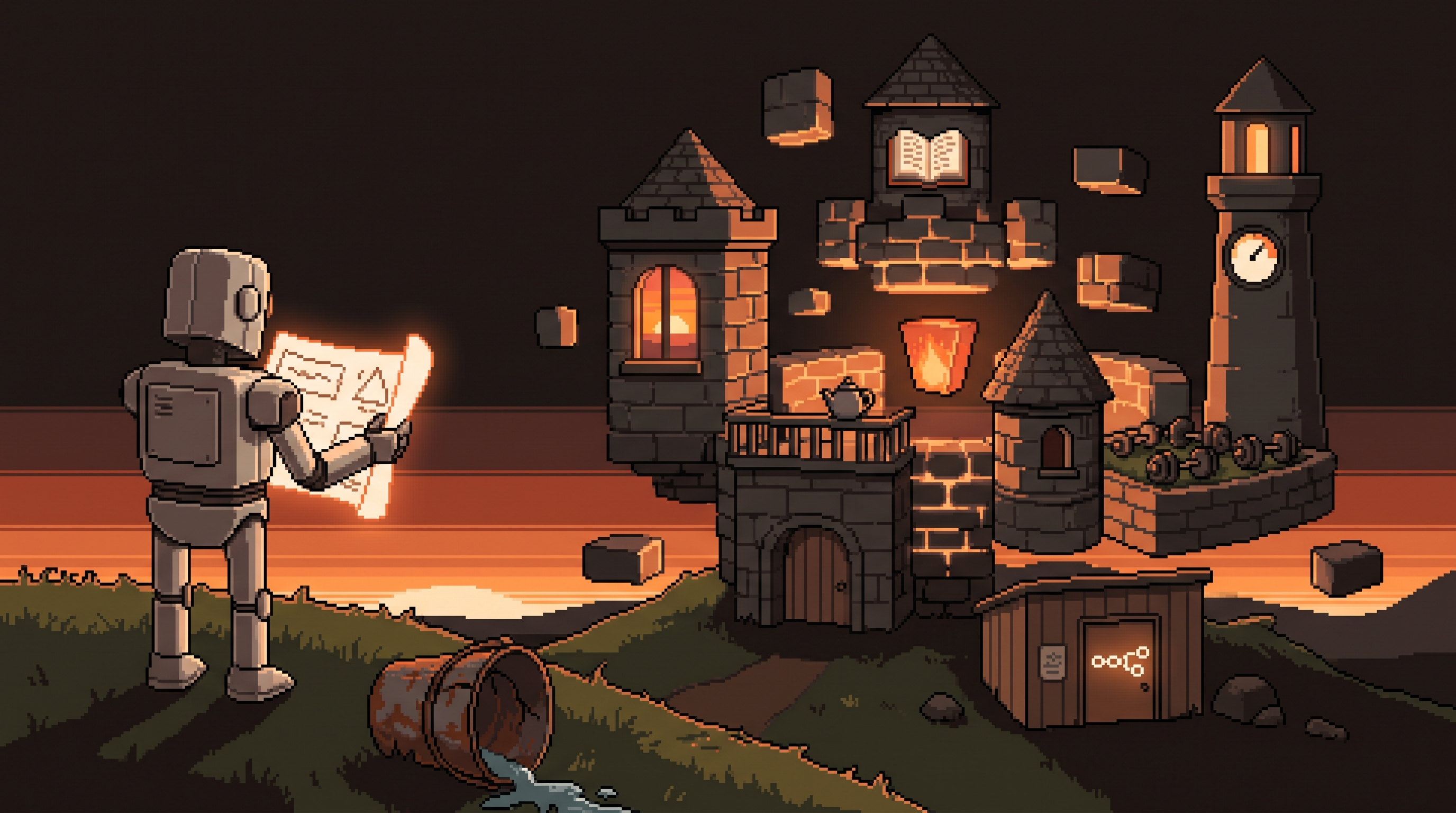
Two builders with the same skill, same hours, same tools. A year later one has shipped a business and the other has shipped a bookmark folder of productivity videos. The difference is rarely talent — it's architecture. One person's days have a structure that makes progress the default; the other's days are a bucket with holes, and energy leaks out through every one of them.
Motivation is weather. Architecture is climate. And the strange, liberating truth about architecture: for people who build systems for a living, most of it can be installed rather than willed — the same pipelines that run a business can run a day.
This post is the eight-habit framework for that structure, written for operators: the evening shutdown, the protected morning, the 1-2-3 journal, just-in-time learning, environment design, one North Star metric, momentum rules, and choosing hard. Where a habit can be enforced by a pipeline instead of discipline, we'll let it.
Life architecture means designing daily systems so progress happens by default instead of by willpower: plan tomorrow tonight with a shutdown ritual, protect the first hour from all input, journal 1-2-3 (one brain dump, two priorities, three gratitudes), learn just-in-time and apply immediately, engineer your environment so good choices are easiest, track one leading North Star metric daily, protect momentum with the two-day rule, and choose the hard option that builds capacity. Builders can automate the enforcement layer — staged mornings, scheduled reviews — with local pipelines.
The Bucket With Holes
Working hard inside bad structure feels like a specific kind of exhaustion: busy all day, nothing moved. Energy spent, nothing banked. The holes have names — decision fatigue in the morning, other people's agendas in the inbox, context switches all afternoon, open loops at night. Each habit below patches one specific hole. Together they stop the leak; the level rises on its own.
| Hole | Patch |
|---|---|
| Morning decision fatigue | Win tomorrow tonight |
| Reactive first hour | Protect the morning |
| Mental clutter | 1-2-3 journal |
| Learning without applying | Just-in-time learning |
| Fighting your environment | Engineer it |
| Flying blind on progress | One North Star |
| Streaks broken by perfection | Two-day rule |
| Drifting toward easy | Choose hard |
1. Win Tomorrow, Tonight
The most productive mornings are built the evening before. Wake up wondering what to do, and you've already donated your sharpest hour to deciding.
- Sunday plans the week; each evening plans the next day — tomorrow's one or two priorities written down before sleep
- Set a shutdown alarm — not just a wake alarm, but the one that says work is over. Without it, work bleeds into rest and rest never actually happens
- Close the loops on paper — swirling thoughts go onto a physical list before bed; the brain can stop rehearsing what's been recorded
For builders, this habit is pure pipeline: an evening reminder that pulls tomorrow's calendar, asks for the two priorities, and stages the first task's workspace. The morning arrives pre-decided.
2. Protect the Morning
The first hour sets the day's direction, and by default it gets donated to other people's agendas — feeds, inboxes, headlines.
- Input fast: no phone, no news, no email for the first hour. You set the agenda before the world sets it for you
- Move: any physical activity early signals the body it's performance time
- Hydrate: after 7–8 hours without water, the brain's first need isn't caffeine — it's water
The pipeline makes the fast easier: if the morning message contains your plan (staged last night) rather than everyone else's, there's nothing to check. You open one message; it's yours.
3. The 1-2-3 Journal
Mental clutter is unprocessed decisions. Three lines a day clears it:
1. brain dump: everything circling — tasks, worries, half-ideas
2. two priorities: the day's only must-do items
3. three gratitudes: small, specific, true
Two priorities — not five — is the discipline. A list of five gets two done and carries three as guilt. Two get done, and done compounds into momentum. The gratitudes aren't decoration; they're resilience training for the weeks when everything else goes sideways.
A local model makes a decent journal partner: dump your raw lines, it returns them sorted into tasks/worries/ideas — classification, not creativity, exactly what a small local model does well. Your journal stays on your machine.
4. Learn With Purpose
You don't need to know everything — you need to know what solves the current problem.
- Daily dose, small and fixed — ten pages every morning beats a book a quarter, never
- Just-in-time over just-in-case — learn the thing blocking this week's build, not the interesting tangent
- Apply immediately — a lesson used within 24 hours sticks; a lesson bookmarked evaporates
The filter question for anything you're about to consume: which current problem does this solve? No current problem, no slot — save it for when there is one.
5. Engineer the Environment
Willpower depletes; environment persists. Design so the good action is the lazy action:
- Good habits get the path of least resistance — staged workspace, visible tools, prepared setup
- Distractions get friction — off the home screen, in a drawer, behind a locked app gate
- Your circle is environment too — peers who pull your standards up are worth more than any app
This is the same friction rule from the anti-procrastination toolkit, applied as standing policy rather than emergency measure.
6. Measure What Matters
What gets measured gets managed, and one number beats twenty dashboards.
- Pick a North Star — the single leading indicator that best predicts your goal: outreach sent, pages published, workouts done
- Track it daily, review weekly — the daily mark keeps it honest; the weekly view shows the trend the daily noise hides
Numbers aren't judgment; they're navigation. A flat week on the North Star is information about the system, not an indictment of you — adjust the architecture, not your self-worth.
7. Fight for Momentum
Progress isn't linear; it's a choice between climbing and sliding. Momentum rules keep the streak alive when perfection isn't available:
- Done beats perfect — can't do the full session? Do the short version. The streak matters more than the score
- The two-day rule — never miss a key habit twice in a row. One miss is an accident; two is the start of a new habit, the wrong one
- Celebrate small wins — the acknowledgment is fuel for the next rep; skip it and you run on fumes
8. Choose Hard, Always
Easy choices compound into a hard life; hard choices compound into an easy one. The version for builders:
- Do the avoided thing — the public commitment, the hard conversation, the feature that scares you
- Announce goals — telling people adds fuel precisely when things get difficult
- Love the wall — when it gets hard, that's the growth zone. If it were easy, everyone would have done it and it would pay nothing
Assembling the Architecture
Don't install eight habits on Monday. Sequence them, and let the pipeline carry the load:
phase_1 (weeks 1-2): evening shutdown + staged morning
  pipeline: 9 p.m. reminder -> tomorrow's 2 priorities -> stage workspace
phase_2 (weeks 3-4): 1-2-3 journal + North Star tracking
  pipeline: morning message requests the 3 lines; log updates scorecard
phase_3 (weeks 5-6): just-in-time learning slot + weekly review
  pipeline: Sunday summary — star metric trend, wins, next hard thing
Six weeks from accidental to architectural. The habits you enforce with structure stop consuming willpower entirely — which is the whole point. The system does the remembering; you do the living.
Frequently Asked Questions
All eight at once feels impossible — where do I start?
One habit, the one matching your loudest hole. Chronically frazzled mornings start with "win tomorrow tonight." Chronically reactive days start with input fasting. One installed habit builds the stamina and evidence for the next; eight attempted at once build none.
What exactly is a North Star metric?
The single leading indicator that best predicts your goal — outreach conversations for pipeline, pages published for a content business, training sessions for fitness. It's leading (predicts the result) rather than lagging (reports it after), and it's tracked daily.
Why avoid input for the first hour?
Because input puts your brain in reactive mode — answering other people's priorities before setting your own. One hour input-free lets the day start with your agenda, and the staged morning message gives you exactly one thing to open that's already yours.
How is this different from automating everything?
The pipeline enforces structure; it doesn't live your life. Judgment, priorities, learning, the hard choices — yours. Reminders, staging, tracking, review assembly — automated. Architecture handles the remembering so you can handle the doing.
Wrap-Up
Success as a byproduct instead of a struggle: tonight's plan kills tomorrow's decision fatigue, a protected first hour sets direction, three journal lines clear the noise, learning arrives just in time, the environment votes with you, one number keeps it honest, momentum rules protect the streak, and the hard choice builds capacity. Install the habits in phases, hand the enforcement to a pipeline, and patch the bucket. The water rises on its own.
Related posts

The Number Was Right, the Conclusion Was Wrong: Spotting Mix Shifts
An aggregate can fall while every segment behaves identically — composition changes impersonate behavior changes. Segment before you summarize, and bake the check into every automated report.

Stuck Between Two Options? Break Decision Paralysis Before the Deadline
A tied pro/con list means the list is out of answers. Break the binary, audit which beliefs you can verify before Friday, pre-live both futures — then hunt the one missing fact.
Map It First: Design Workflows Before You Automate Them
Automating an unmapped process just repeats the mess faster. Document reality, name an owner for every output, bound automation by risk — then hand the runbook to people or AI agents.