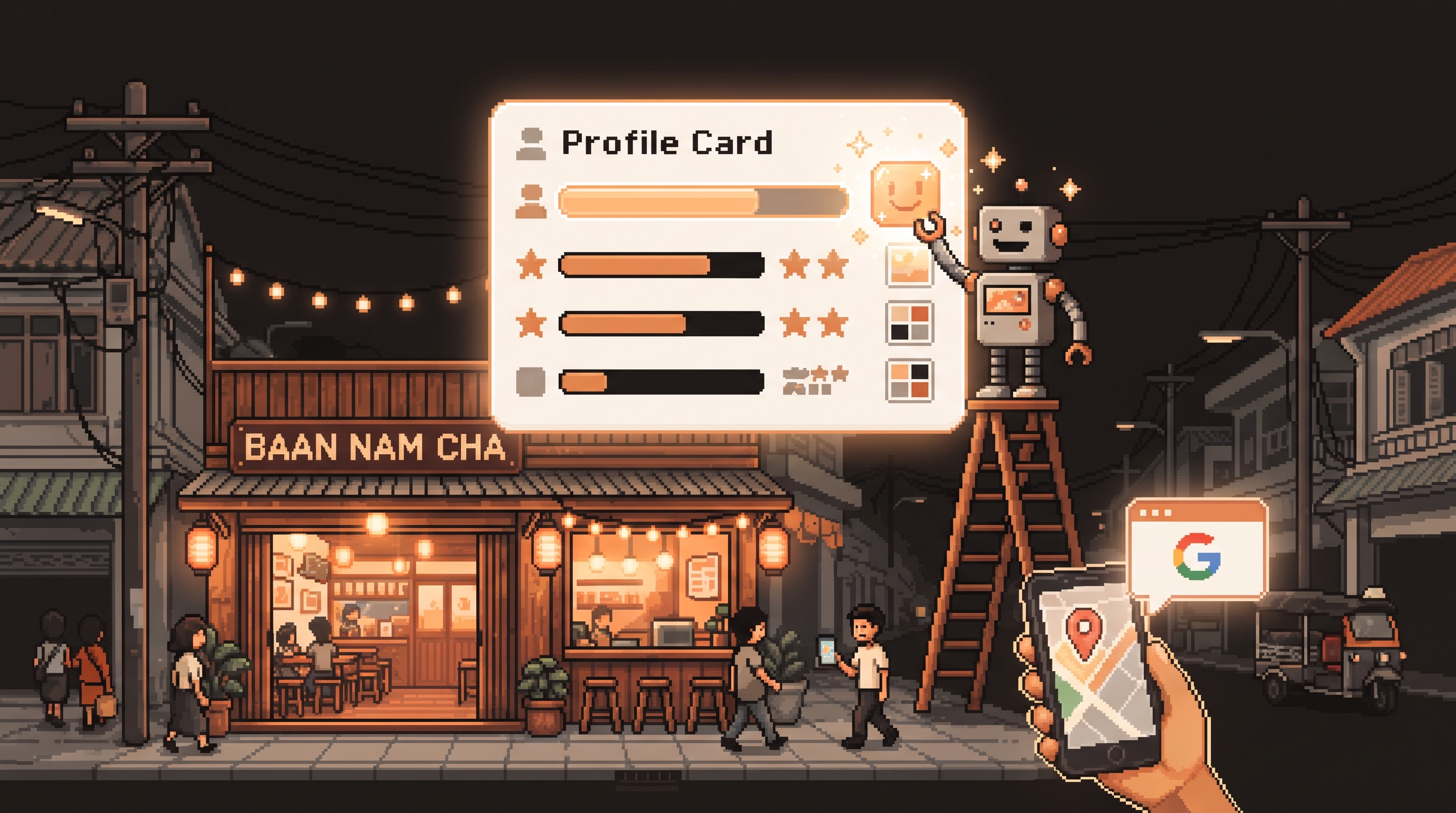
Google Business Profile Optimization for Bangkok Businesses: What Actually Moves the Needle
Your Google Business Profile is your second storefront, and for many searches it's the first one customers ever see. Before anyone visits your website — before they even know it exists — they see your name, your rating, your photos, and three competitors in a row underneath.
Most Bangkok businesses set the profile up once, uploaded three photos, and haven't touched it since. Meanwhile the café across the soi — worse coffee, better profile — outranks them consistently. That's not luck. Google's local pack reads a specific set of signals from your profile, and most owners are sending weak ones by accident.
This is a working tour of those levers, ranked roughly by how much they actually influence where you appear: categories first (they decide which contest you're even in), then services, reviews, photos, posts, and Q&A. Everything here is doable in an afternoon, in the Google Business Profile dashboard, for free.
Google Business Profile optimization means keeping the fields Google's local pack actually reads strong and current: accurate primary and secondary categories (the single highest-impact field), complete service/product listings, a steady flow of keyword-bearing reviews in both Thai and English, fresh photos, regular Google Posts, and seeded Q&A. It also means avoiding the account-killers: keyword-stuffed business names, mismatched categories, and inconsistent name-address-phone across the web. :::
Categories Decide Which Contest You're In
The primary category is the single most powerful field on the profile. Google uses it to decide which searches you're eligible for at all. A café categorized as "Restaurant" competes in the restaurant pack — against every hotel buffet and street-food giant — and is partially invisible in "café near me" searches where "Coffee shop" businesses dominate.
Rules of thumb:
- Primary = the one thing you most want to be found for. Not the most prestigious, the most profitable.
- Secondary categories cover the rest. A dental clinic in Sukhumvit might add Orthodontist, Cosmetic Dentist, Pediatric Dentist — each unlocks related searches without diluting the primary.
- Fewer and truer beats more and hopeful. Ten tenuously relevant categories dilute relevance signals; four accurate ones sharpen them.
- Re-check after Google renames categories. The taxonomy changes a few times a year; a stale category silently drops you from searches you used to win.
Category mistakes are invisible from inside your own profile — everything looks fine, you're just competing in the wrong arena. A grid scan (checking your rank at many points across your area, which we covered previously) that's weak even at your own doorstep is the classic symptom of a category problem.
Services, Products, and the Description: Boring, and Load-Bearing
Under each category you can list specific services with descriptions. This is where long-tail relevance lives: "Invisalign consultation", "น้ำแข็งใส delivery", "visa document translation". Write them the way customers search, because the profile text is indexable.
{
  "category": "Coffee shop",
  "services": [
    { "name": "Single-origin pour over", "description": "Rotating Thai single-origin beans, brewed to order" },
    { "name": "Coffee bean delivery", "description": "Whole-bean delivery across Sukhumvit and Thonglor, same day" }
  ]
}
The business description is 750 characters of low drama: what you do, for whom, where, in plain language. First 250 characters carry the most weight — lead with the offering, not the founding story. And Bangkok-specific: if you serve customers in both languages, let the description say so naturally. Bilingual service names (where honest) capture both language lanes in one profile.
Reviews: The Engine Room
Reviews influence local pack ranking and, just as much, the click decision. The mechanics that matter:
- Velocity beats volume. Thirty reviews arriving steadily over six months signal a living business; thirty in one week after a QR-code blitz signals a campaign — and reads that way to customers too.
- Keywords in review text carry local relevance. A review that says "best latte in Thonglor, staff explained the beans in English and Thai" is worth five generic "nice place" reviews. You can't write reviews, but you can hint: a small sign or a follow-up message asking customers to mention what they came for.
- Both languages. Thai customers write Thai reviews, expats write English ones — a healthy Bangkok profile accumulates both, and each language's searches read their own side.
- Reply to everything, in the reviewer's language. Replies are profile content too: they show recent activity, demonstrate responsiveness, and are another small indexing surface.
Never buy or incentivize reviews — beyond policy risk, fake-review patterns (identical phrasing, reviewer clusters) are something both Google and customers increasingly spot.
Photos: Freshness Is the Signal
Google has stated that photos don't directly rank the profile — and in practice, businesses that feed photos steadily almost always outperform identical profiles that don't. Why: activity signals, click engagement (profiles with better photos get more interaction, which compounds), and the photo-derived keywords (geotags, file names, auto-captioning) that feed relevance.
A sustainable rhythm beats a dump:
- New photos weekly, not 40 at once then silence.
- Mix exteriors (finding you matters at night in Bangkok's sois), interiors, products, and staff at work.
- Real beats polished. Phone photos of actual dishes outperform stock imagery — customers and Google both discount generic shots.
Google Posts and Q&A: Two Underused Slots
Posts are the short updates in the profile's Updates tab — offers, events, new menu items. They expire, they don't rank you directly, but they are timestamped proof of an active business, and they're prime real estate in the profile view itself. One post a week mentioning a real, specific thing ("new rainy-season blend, iced versions available") beats a month of generic slogans.
Q&A lets anyone ask a question on your profile — and the answers are public forever. Unclaimed Q&A is a risk: outdated answers from random strangers become the truth. Seed it yourself with your most-asked questions, in both languages where relevant: parking, hours differences (does the kitchen close before the bar?), delivery areas, English-speaking staff. It's also the gentlest place to naturally include neighborhood and service keywords, because they're answers to real questions.
The Killers: What Gets Profiles Suspended or Silently Buried
| Practice | Why it tempts | What actually happens |
|---|---|---|
| Keyword-stuffed business name ("Baan Coffee Sukhumvit Café ร้านกาแฟ") | Looks like free relevance | Policy violation; suspension risk; the name field is meant to be your real name |
| Mismatched categories to widen reach | More contests, more wins? | Diluted relevance; wrong-pack competition |
| Virtual office / fake locations | Extra map pins | Suspension, and often the whole account |
| Inconsistent NAP across directories | Nobody checks those sites | Citation confusion; Google's confidence in your address drops |
| Stale hours (holiday hours never updated) | Too busy | "Closed" shown to customers who were on their way; engagement and trust drop |
NAP — name, address, phone — consistency deserves its own pass: same format everywhere it appears (Facebook, LINE OA page, directories, your site footer). Same phone digits, same address rendering, same name. Google cross-checks these, and mismatches quietly erode the profile's trust score.
A One-Afternoon Checklist
- Verify the primary category honestly; add up to four accurate secondaries.
- List every real service/product with search-shaped names; write the 750-char description, offering first.
- Audit hours — including special hours for upcoming Thai holidays — and attributes (outdoor seating, halal, English-speaking staff).
- Set a photo rhythm: a few real photos weekly; exteriors at night included.
- Build the review engine: ask at the moment of delight, mention-what-you-came-for hint, reply to every review in its language.
- One Google Post per week about something specific and true.
- Seed five Q&A pairs from your most-asked questions, Thai and English.
- Fix NAP everywhere it appears, one consistent format.
- After a month, re-scan your grid to see what moved — before/after on the same grid is the only honest scorecard.
Frequently Asked Questions
How long does GBP optimization take to show results?
Category fixes and NAP cleanup can shift local pack position within days to a couple of weeks. Review velocity and posting rhythm compound over months. Profile work is a flywheel, not a switch — the first weeks move the needle least visibly, and the businesses that quit then are the ones that hand the neighborhood to competitors.
Should my business name include my neighborhood or service?
No — the name field must be your real-world business name, nothing more. Adding "Sukhumvit Dental Clinic" to a business actually named something else is a keyword-stuffing violation that risks suspension. Put location and service signals in categories, services, posts, and review replies instead; those fields are built to carry them.
Do Google Posts help ranking?
Indirectly. Posts don't feed the ranking algorithm directly, but they keep the profile demonstrably active, occupy visible space with your messaging, and drive profile engagement — which loops back into performance. One specific, truthful post a week is the sustainable cadence.
Is it worth managing the profile in both Thai and English?
In Bangkok, yes — they're two different search populations with two different review pools. You don't need to translate everything: bilingual services and Q&A where natural, replies matched to each reviewer's language, and let reviews accumulate organically in both. The profile that speaks both lanes collects both audiences.
The profile isn't a form you fill in once; it's the room Google watches to decide whether your business is alive, what contest you belong in, and whether the last customer loved you. Categories put you in the right arena, reviews and activity keep you climbing it.
Want to see where you currently stand before you start? Run a free Google Maps grid scan for your business at gbppeak.com/free-maps — no signup needed to see where you rank across your service area.
Related posts

Why Your Google Maps Rank Changes Depending on Where You Stand in Bangkok
Your shop ranks #1 in Ari and misses the top 10 at Asok — same hour, same city. There is no single Bangkok rank. Geo-grid tracking shows your real footprint.

Where Should Local AI Live? A Deployment Shape for Every Work Role
Same four downloads for everyone — Ollama, n8n, a model. But your role already decided where it runs: desk rig, work laptop, mini server, or LAN-only box.