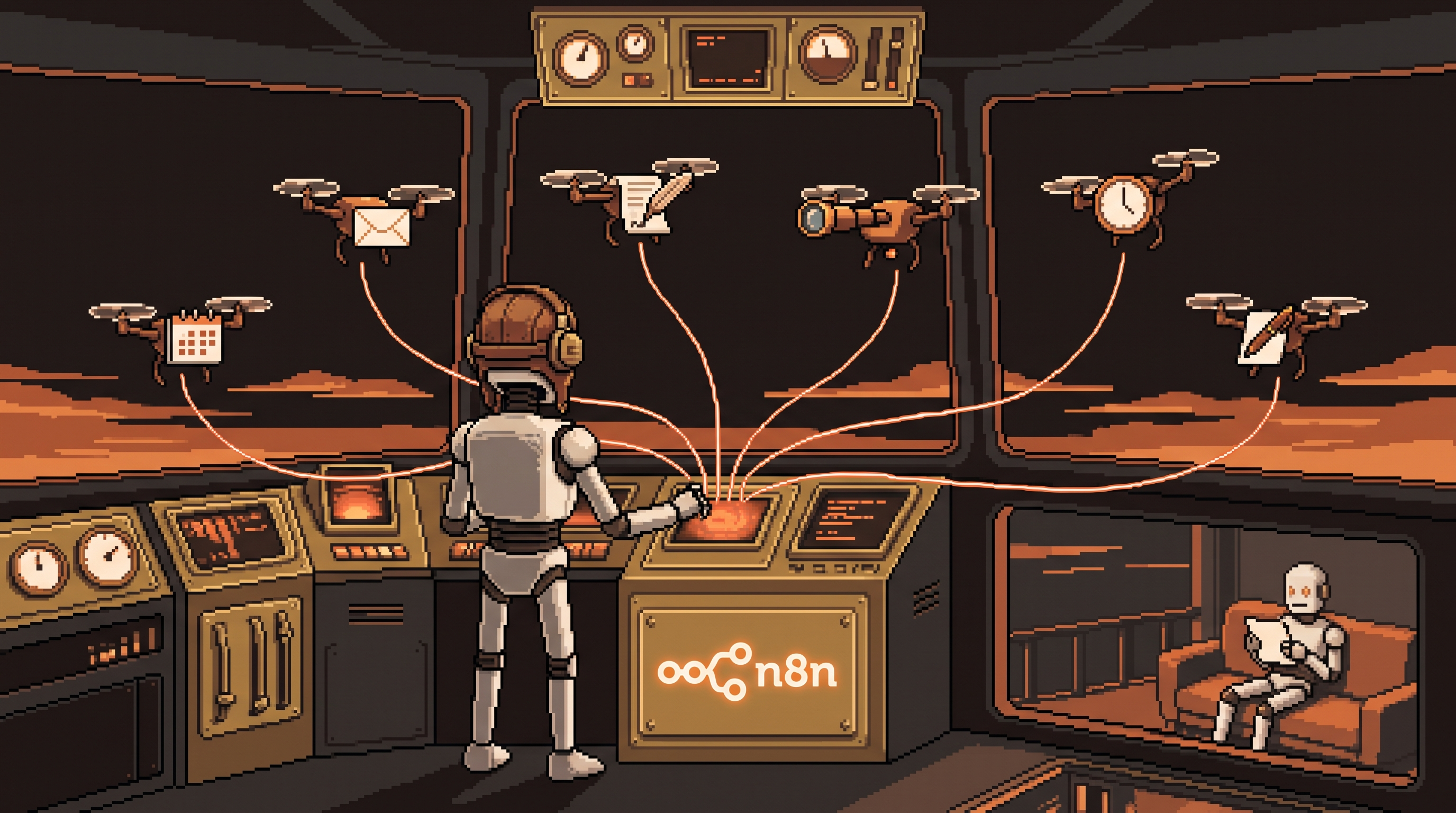
The question every executive quietly asks — "will AI replace my assistant?" — has the wrong shape. Here's the version that actually plays out: AI won't replace your EA. An EA who commands AI tools will replace one who doesn't. Same desk, same job title on paper, and a 5x difference in what comes out of it.
The old EA was a human buffer between the executive and logistics: calendar, travel, notes, gatekeeping. Valuable, and entirely manual — which meant the role's ceiling was one person's hours. The upgraded role is different in kind: an architect who builds the systems that do the tasks, then manages those systems instead of executing each item by hand.
(Solo operators: this is the same upgrade I covered in the chief-of-staff pipeline piece, where a cron job plays the EA. This one is for leaders with actual humans on the team — the even better version.)
Executive assistants aren't replaced by AI — they're upgraded by it. An EA who masters AI tools transitions from task executor to systems architect and de facto Chief of Staff: using AI for the middle 80% of work (drafts, transcriptions, summaries, scheduling automation) while the executive provides vision and final polish. Building context banks from past emails and brand guidelines lets the assistant surface solutions for approval instead of problems for solving — turning a reactive role into a strategic one.
From Sticky Note to Fleet Commander
The clearest way to see the shift is what the EA actually operates:
| Old-world EA | Upgraded EA |
|---|---|
| Operates | a calendar and inbox |
| Executes | tasks one at a time, by hand |
| Asks you | "how do you want to handle X?" |
| Output ceiling | one person's working hours |
| Upgraded operates | a fleet of AI tools and pipelines |
| Builds | the systems that execute the tasks |
| Brings you | solutions ready for approval |
| Output ceiling | the systems' throughput |
"Fleet commander" isn't a metaphor for decoration. A modern EA runs meeting-intelligence tools, inbox routing rules, research agents, and drafting pipelines — each one handling volume no human could, all of them needing exactly one human's judgment to aim and approve. The executive who understands this stops hiring for typing speed and starts hiring (or training) for systems thinking.
The 10-80-10 Rule, AI Edition
The delegation pattern where this pays off fastest:
- First 10% — vision. The executive supplies direction: a voice note, a rough brain dump, the outcome wanted.
- Middle 80% — execution, now machine-assisted. Drafts generated from the brief, meetings transcribed and summarized, project structures assembled, documents formatted. The EA's job shifts from producing this layer to directing and quality-controlling it.
- Final 10% — polish. The executive reviews and approves.
The concrete example that sells it to any skeptic: documenting a new company procedure used to mean a two-hour meeting plus a day of write-up. Now it's a five-minute voice note from the executive → transcription → a structured step-by-step draft generated against the brief → the EA checks it against reality → it lands in the project tool. Minutes instead of days, and the human time went into the two ends where judgment lives.
The Context Bank: Preemptive Support
The second upgrade changes what arrives in your inbox. A reactive assistant brings problems: "here's a situation, what do you want to do?" A preemptive one brings solutions: "here's the situation, here's the draft response in your voice, approve or adjust."
The machinery is a context bank — the accumulated material that makes AI output sound like you rather than like a model:
context_bank:
  voice:
    - past emails you approved
    - speeches and posts in your register
    - banned phrases, sign-off rules
  relationships:
    - contact history per stakeholder
    - sensitivities, preferred tone per person
  decisions:
    - past rulings on similar questions
    - standing policies and their exceptions
With that loaded, the workflow becomes: AI drafts in your voice → EA verifies facts and fit → your inbox shows finished options instead of open questions. The noise filter is the point; every item that reaches you has already survived two quality gates.
The Stack an Upgraded EA Runs
Three layers cover most of the leverage:
- Meeting intelligence — transcription and summary tools produce the record; the EA's job narrows to extracting decisions, owners, and deadlines (and transcribing locally keeps client conversations off third-party servers)
- Scheduling and inbox — routing rules and draft automation handle the back-and-forth; the EA tunes the rules instead of performing them
- Research agents — briefs assembled before every meeting: who's joining, their history with you, the topic landscape, the open questions
Each layer is the same trade: the machine takes volume, the human takes judgment. The EA who configures the layers becomes the person who decides what judgment gets applied where.
The Empowerment Pivot
Now the management question, because this transition lives or dies on how it's communicated. Tell an assistant "we're automating your tasks" and you get fear and quiet resistance — the tools get sabotaged by omission. Tell them "you're being promoted from doing the work to commanding the systems that do it" — with budget, permission to experiment, and a path to Chief of Staff scope — and you get the opposite: the person most motivated to master the tools is the one whose job gets more interesting.
The practical rollout:
week 1: pick ONE repetitive task (meeting notes or
        first-draft emails) — automate it together
week 2-3: EA owns the tool, tunes it, reports friction
month 2: second and third workflows; context bank v1
month 3+: EA proposes the next automation themselves —
          the fleet commander is now self-directing
The tell that it's working: the EA starts bringing you automation proposals you didn't ask for. That's the moment the role has genuinely changed — and it's also when the executive's calendar mysteriously starts clearing.
What Stays Human
The upgraded EA doesn't remove judgment from the operation; it concentrates it. Three things remain permanently human: relationship handling for sensitive stakeholders, the final call on anything client-facing, and the taste calls the context bank can't make ("this draft is technically fine and tonally wrong"). The system produces volume; the people produce the decisions volume is worth having.
Frequently Asked Questions
Will AI replace my assistant's job?
No — but an assistant using AI will outperform one who isn't. The role is evolving from executing tasks to managing the systems that execute them. The tasks go to the machines; the oversight, tuning, and judgment concentrate in the person.
How do I start this with my current EA?
One repetitive task, permission, and a small budget. Automate meeting transcription or first-draft emails together, let them own and tune the tool, and expand from there. The transition needs their buy-in more than your mandate — frame it as promotion, because it is.
What exactly is a context bank?
The collection of your specific material — past emails, transcripts, brand voice, decision history — loaded so AI outputs are tailored to you instead of generic. It's what turns "a draft" into "a draft that sounds like it came from this office."
Isn't this just dumping more work on the assistant?
It's trading execution work for systems work — less typing, more configuring and quality-controlling. Most EAs who make the shift report the role getting more interesting, not heavier, because the repetitive layer they never enjoyed is the layer that automated first.
Wrap-Up
Executive support isn't becoming human-versus-machine; it's becoming human-commanding-machines. Give your assistant the mandate, the budget, and the frame — automation of the bottom 80% is their promotion to Chief of Staff, not their replacement. Context banks make the output sound like you, the 10-80-10 split puts judgment at both ends, and the fleet commander runs the middle. The executives who get this keep their best people and multiply them.
Related posts

The Number Was Right, the Conclusion Was Wrong: Spotting Mix Shifts
An aggregate can fall while every segment behaves identically — composition changes impersonate behavior changes. Segment before you summarize, and bake the check into every automated report.

Stuck Between Two Options? Break Decision Paralysis Before the Deadline
A tied pro/con list means the list is out of answers. Break the binary, audit which beliefs you can verify before Friday, pre-live both futures — then hunt the one missing fact.
Map It First: Design Workflows Before You Automate Them
Automating an unmapped process just repeats the mess faster. Document reality, name an owner for every output, bound automation by risk — then hand the runbook to people or AI agents.