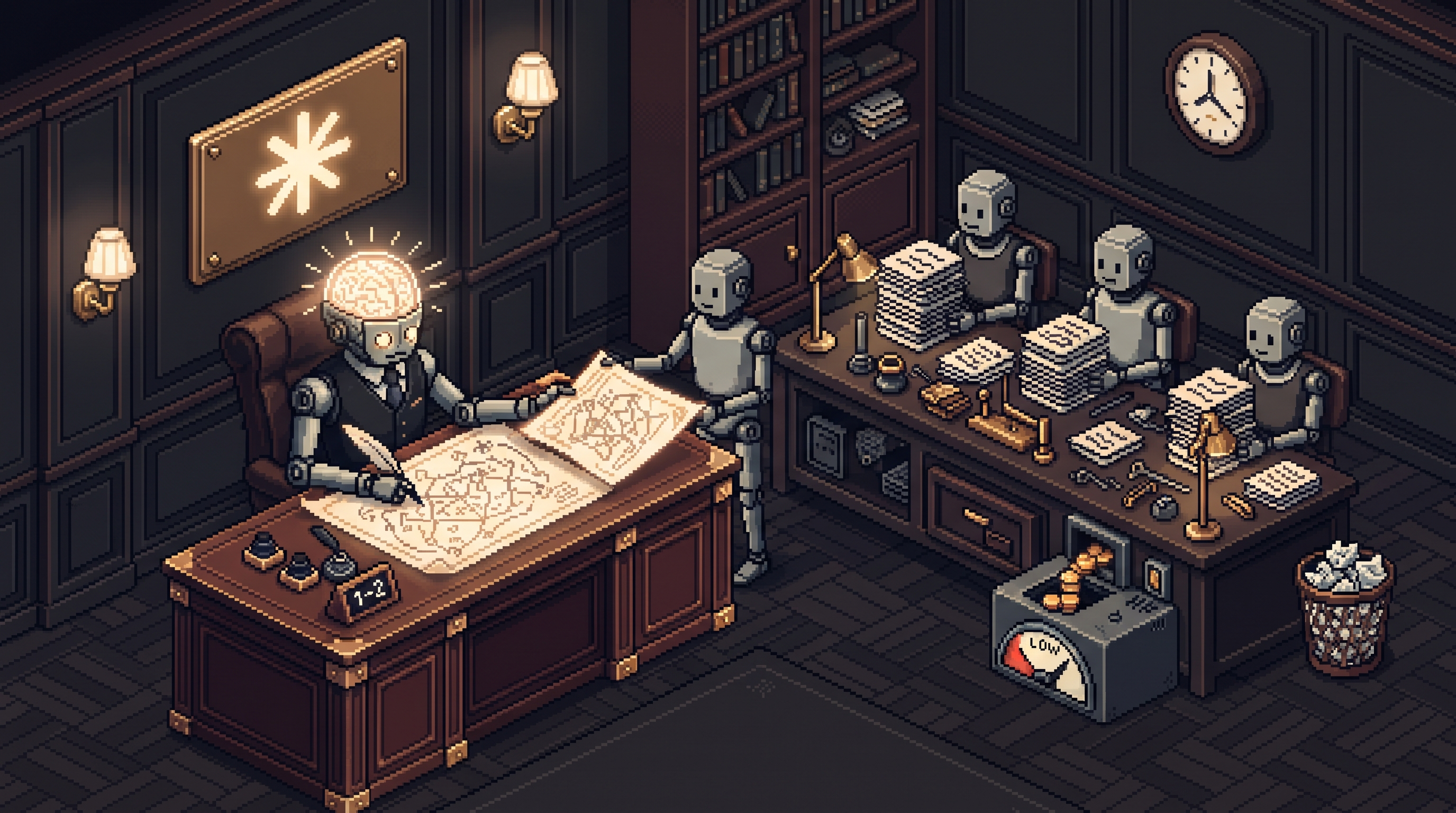
Here's a bill that surprises everyone the first month they get access to a top-tier model: the deep-thinking sessions that solved your hardest problem cost more than everything else you did that week combined. Not because you did anything wrong — because you let the senior partner proofread the emails.
Top-tier Claude reasoning (the Fable class of models) is the strongest thinking currently on tap in the ecosystem, and it is priced like it. The capability isn't the hard part; the economics are. Most people either waste the big model on linear chores or avoid it entirely out of bill anxiety. Both mistakes come from treating all AI as one interchangeable blob.
The mental shift that fixes it: stop seeing "Claude" as one assistant and start seeing it as a consulting firm with a billing structure — an expensive senior consultant, capable mid-tiers, and a fast cheap junior. This guide covers the hierarchy, when to call which chair, how to prompt the expensive tier so it actually earns its rate, and the context that makes any tier perform like a bigger one.
Use top-tier Claude models like Fable-5 only for what their price implies: complex planning, contradiction-finding, high-stakes strategy — one or two "thinking" turns at the start of a project. Hand the resulting roadmap to cheaper tiers (Sonnet/Opus) for execution at volume. Prompt the expensive tier with goals and constraints rather than narrow tasks, stress-test decisions by asking it to argue against its own recommendation, and ground everything in your context (files, project instructions, integrations) so even mid-tier models answer like insiders.
The Hierarchy: Four Chairs, Four Bills
| Model | Character | Best at | Cost profile |
|---|---|---|---|
| Haiku | the fast junior | triage, summaries, high-volume simple work | cheapest, quick |
| Sonnet | the capable associate | daily drafting, code, standard execution | moderate |
| Opus | the senior associate | complex work, careful analysis | high |
| Fable | the senior partner | multi-variable strategy, contradiction-finding, deep synthesis | top of the sheet |
The difference between tiers isn't polish — it's complexity handling. Any tier can write a follow-up email. Only the top tier reliably holds twelve interacting variables, notices that assumption #3 contradicts the data in the appendix, and tells you so before you ship.
That capability is exactly why the routing decision matters: paying partner rates for associate work is the most common waste in AI budgets, and it feels virtuous because the outputs are great. They're also identical to what the cheaper chair would have produced.
The Senior Consultant Pattern
The highest-leverage cost structure in AI work today:
- Book the senior consultant for the thinking phase — one or two turns with the top model: "here's the mess, here's what matters, design the strategy." Out comes a roadmap: decisions made, steps ordered, constraints captured.
- Hand the roadmap to an associate — the execution phase (drafts, variations, volume production) runs on Sonnet-class pricing, following a plan that already contains the expensive thinking.
The math is the whole argument: a session where 5% of tokens are partner-rate and 95% are associate-rate performs like a premium engagement and bills like a standard one. The reverse ratio — partner model grinding through execution turns — is how "the AI got expensive" happens.
routing_rule:
  thinking_phase:      # unknowns, tradeoffs, strategy
    model: fable_class
    turns: 1-2
    output: roadmap + decisions + constraints
  execution_phase:     # known steps, volume work
    model: sonnet_class
    turns: as many as needed
    input: the roadmap, verbatim
The tell you're misrouting: you already know the steps and just want them done. Linear tasks never need the top tier — no matter how important they feel.
Prompting the Expensive Chair: Goals, Not Tasks
Top-tier reasoning is wasted on instructions, because instructions pre-decide the thinking. Feed it objectives instead:
| Task prompt (small thinking) | Goal prompt (full thinking) |
|---|---|
| "Write a follow-up email for this lead" | "This client hasn't responded in three weeks. Goal: get them to book a call without sounding pushy. Here's our history — suggest a strategy." |
| "Summarize these notes" | "Find the argument in these notes: where do sources conflict, and what would I conclude if I trusted each one?" |
| "What do you think of this plan?" | "Stress-test this plan. Argue against your own first recommendation. What breaks under my top three constraints?" |
A task tells the model what to skip past; a goal tells it what to solve. The second column is what partner-tier rates are for — the first column gets identical-or-better results from the mid tiers.
Three Tactics That Keep Big Models Honest
Decision-review framing. Don't ask for opinions; ask for adversarial review. Provide your priorities and constraints up front, request risks, and require the model to argue against its own initial recommendation. The counter-argument pass is where hidden flaws surface — praise never finds them.
Research-and-synthesis loop. With a pile of transcripts or documents, ban the summary. First instruction: "identify where these sources conflict and present the conflicts before drafting anything." Synthesis that starts from disagreement is worth reading; synthesis that averages is slop with footnotes.
Ground rules in the opening prompt.
MODE: feedback only — do not produce the deliverable yet
EVIDENCE: label every claim [PROVEN] or [INFERRED]
VOICE: match the attached samples, not a generic style
ESCALATE: if a decision exceeds the stated constraints, stop and ask
These four lines prevent the three expensive failure modes: over-eager execution, confident guessing, and generic-professional voice.
Context: The Real Multiplier
Model tier is the visible dial; context is the hidden one. A mid-tier model loaded with your actual documents routinely beats a top-tier model guessing from training data. Before upgrading the chair, feed the meeting:
- Files — PDFs, spreadsheets, exports: the facts the model cannot invent
- Project instructions — persistent rules so the brand, tone, and constraints ride along without re-pasting
- Integrations — email and calendar connections so the advice references your real schedule and history, not a hypothetical one
The same logic extends locally: for sensitive strategy documents, a mid-tier local model with full context often outperforms a cloud partner model working blind — at zero marginal cost and zero exposure. Upgrade context first, tier second; it's cheaper and it compounds.
Frequently Asked Questions
Why is the top tier so much more expensive?
Because deep reasoning is computationally heavy — the model runs extended multi-step thinking before answering. You're paying for evaluation, contradiction-checking, and synthesis depth, not for prettier sentences. That's precisely why it belongs in short, high-stakes bursts rather than all-day use.
Can I get top-tier thinking without top-tier bills?
Yes — the hybrid pattern: one or two turns of the expensive model to build the roadmap (decisions, steps, constraints), then execute everything on a cheaper tier following that plan. The strategy carries the premium; the volume carries the discount.
What's an Artifact in Claude?
A dedicated window where Claude renders more-than-text output — a mini-application, a layout, a dashboard, an interactive chart. Useful with any tier; the top tier designs them, the mid tiers iterate them.
How do I know I'm overusing the expensive model?
Audit your last week of threads. If the top tier spent most of its turns on summaries, edits, and known-step execution, you're paying partner rates for associate work. The fix is the routing rule — thinking up top, execution below.
Wrap-Up
The top of the model stack isn't a lifestyle, it's an instrument — booked for the thinking phase, briefed with goals and constraints, kept honest by adversarial review, and relieved the moment the roadmap exists. Route the volume to the associates, feed every tier real context before upgrading any of them, and keep the sensitive strategy work local. The firms that master this don't have bigger AI budgets; they have the same budget pointed at the right chair.
Related posts

The Number Was Right, the Conclusion Was Wrong: Spotting Mix Shifts
An aggregate can fall while every segment behaves identically — composition changes impersonate behavior changes. Segment before you summarize, and bake the check into every automated report.

Stuck Between Two Options? Break Decision Paralysis Before the Deadline
A tied pro/con list means the list is out of answers. Break the binary, audit which beliefs you can verify before Friday, pre-live both futures — then hunt the one missing fact.
Map It First: Design Workflows Before You Automate Them
Automating an unmapped process just repeats the mess faster. Document reality, name an owner for every output, bound automation by risk — then hand the runbook to people or AI agents.