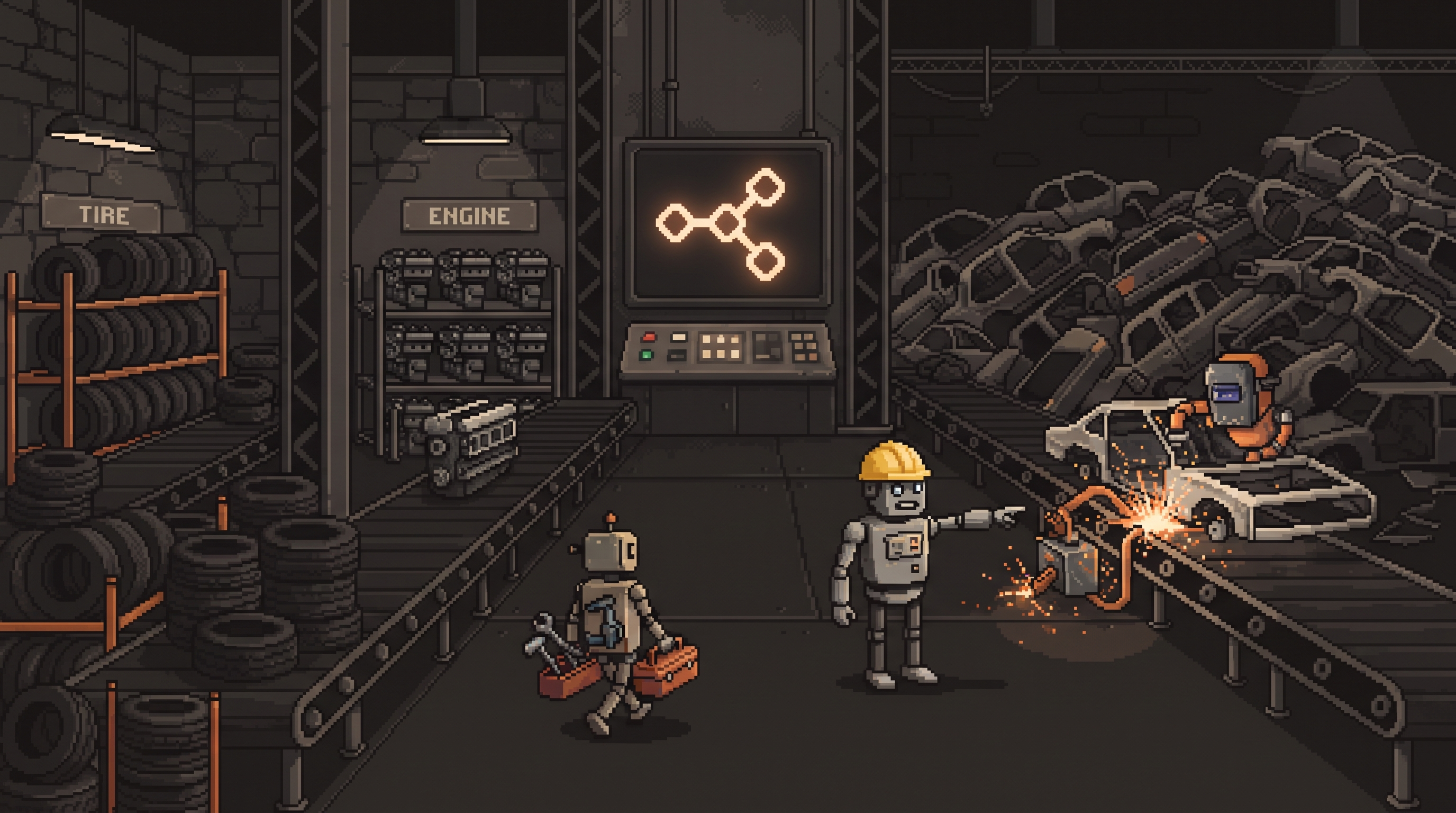
A small car factory makes 8 tires a day, 2 engines, and 1 chassis. How many cars does it build? One. You could double tire production tomorrow and build exactly the same number of cars, because the chassis line — the slowest station — sets the pace of everything downstream.
Now the uncomfortable translation: most automation projects are tire machines. We find the task that annoys us most, script it beautifully, and feel productive — while total output stays frozen, because the thing we automated was never the constraint. The med spa owner drowning in patient messages wants an AI agent for the inbox; her real limit is that she doesn't have enough hands to perform the treatments the messages are booking.
This is the Theory of Constraints applied to automation: a system only moves as fast as its slowest station, and effort spent anywhere else is expensive decoration. Here's how to find your chassis line before you write a single node.
A bottleneck is the one stage that limits total output — everything before it piles up, everything after it starves. To find yours before automating, map every stage from lead to repeat customer, measure throughput at each, and identify where flow actually stops (not where it feels annoying). Automate or expand that constraint first: improving any non-bottleneck stage, however satisfying, changes nothing about total output until the slowest station moves.
Why Smart People Automate the Wrong Thing
Three traps reliably point effort at non-constraints:
- The annoyance trap. Loud, irritating tasks feel important. A flooded inbox demands attention; a leaky sales conversion step stays quiet.
- The novelty trap. New tech is fun to apply somewhere, so we apply it where it's fun — not where throughput dies.
- The visibility trap. You see the messages piling up. You don't see the 60% of consult calls that never convert, because those people just... leave.
None of these correlate with being the constraint. The constraint is found by measurement, not by feeling.
Step 1: Draw the Whole Line
You can't see a stuck station in a line you've never drawn. Lay out every stage a customer travels, from stranger to repeat buyer:
customer_line:
  - stage: lead_generation
    question: "how do they find you?"
    metric_this_month: 120 inquiries
  - stage: response
    question: "how fast do they hear back?"
    metric: 80% answered within 48h
  - stage: conversion
    question: "how many commit?"
    metric: 15% of calls become clients
  - stage: delivery
    question: "how many can you serve?"
    metric: capacity ~40 active clients
  - stage: retention
    question: "how many stay?"
    metric: 8% monthly churn
The discipline is writing a number next to every stage. Numbers turn opinions into a system you can diagnose. If a stage has no number, that's the first thing to instrument — guess.
Step 2: Find Where Flow Actually Stops
With the line drawn, the constraint shows up as one of two patterns:
- Pile-up before it — inquiries waiting, work queued, your team stressed upstream
- Starvation after it — the delivery team idle, calendar holes, capacity going unused
Read both ends. The stage where inventory accumulates in front while everything behind it runs dry is your chassis line.
Run the numbers honestly:
Current monthly flow: 120 inquiries -> 18 clients -> cap 40 -> ~33 active
Stage rates: response 80%, consult booked 30%, convert 15%,
             delivery capacity 40 active
Question: if inquiries doubled tomorrow, which number
breaks first? Which stage leaks the most absolute value?
In that example, doubling inquiries changes almost nothing — the consult-booking rate (30% of a huge number) and conversion (15%) are the leak. Meanwhile "let's get more leads" is exactly what everyone proposes first.
Step 3: Nuisance vs Constraint
The distinction that saves your quarter:
| Nuisance | Constraint | |
|---|---|---|
| Feels | annoying, loud | often quiet, structural |
| If fixed | you feel better | the business moves |
| Test | removing it changes no monthly number | removing it changes the monthly number |
| Example | manually sending routine emails | only one person can perform the core service |
| Priority | eventually, in batches | now, with everything you have |
The coach who "needed more leads" actually had plenty — conversion was the constraint, and it was invisible because nobody dropped off loudly. They simply didn't sign.
Step 4: Attack the Constraint With Everything
When you've found it, redirect resources — including your automation habit — at that one station until it moves:
- Constraint is response time? Automate triage and instant acknowledgment — now automation multiplies output.
- Constraint is conversion? Nothing robotic; build the offer doc, rehearse the call, fix the pricing page — then automate follow-up sequences.
- Constraint is delivery capacity? Template the service, document the process, train or hire — automating marketing while delivery starves just makes the queue angrier.
- Constraint is retention? Fix onboarding and the monthly check-in rhythm before adding a single new lead.
The rule of focus: one constraint at a time, all tools on it, until the bottleneck moves. Then — this is the part people forget — the constraint relocates. Capacity was the limit; you fixed it; now conversion is. Re-run the line every quarter, because yesterday's fix is tomorrow's blind spot.
Automating the Diagnosis Itself
Since we build pipelines: the line review doesn't have to be a whiteboard ritual. A monthly constraint digest keeps the numbers honest:
pipeline: constraint-digest
schedule: "0 8 1 * *"   # first of month
steps:
  - pull: inquiry count, response time, consult rate,
          conversion rate, active clients, churn
  - compute: stage-by-stage throughput + biggest leak
  - compare: vs last month, flag where the constraint moved
  - deliver: one email — "this month's chassis line is X,
             last month it was Y"
The digest runs wherever your numbers live — a local model summarizing the deltas keeps client data in-house. The point isn't dashboard vanity; it's catching the moment the constraint relocates, so next quarter's effort isn't aimed at last quarter's problem.
Frequently Asked Questions
What is a bottleneck in a business context?
The stage that limits total output. Work piles up in front of it and starves behind it. Until that specific stage is expanded or automated, improving any other stage changes the end number by exactly nothing.
How is a nuisance different from a bottleneck?
A nuisance frustrates but gates nothing — fixing it makes you feel better, not bigger. A constraint actively caps growth. Test: if this task disappeared tomorrow, which monthly number moves? No number moves means nuisance — batch it or automate it later.
How do I know I'm solving the wrong problem?
If you're investing heavily in a stage that's already faster than the stage after it. Extra speed upstream of a constraint just builds a bigger queue. Measure stage-by-stage throughput and check where you sit relative to the slowest point.
Does automation count as fixing the bottleneck?
Only when aimed at the constraint. Automating a nuisance feels productive and changes nothing — the med spa's inbox agent doesn't add treatment capacity. Automating the constraint (triage, follow-up speed, delivery templates) is the highest-leverage use of automation there is.
Wrap-Up
The factory builds one car a day no matter how many tire machines you buy. Draw your whole line with a number at every stage, find where the pile-up meets the starvation, and put everything — money, hiring, and especially your automation habit — on that one station until it moves. Then re-check, because the constraint just relocated. Growth isn't about working harder on the line; it's about knowing which station sets the pace.
Related posts

The Number Was Right, the Conclusion Was Wrong: Spotting Mix Shifts
An aggregate can fall while every segment behaves identically — composition changes impersonate behavior changes. Segment before you summarize, and bake the check into every automated report.

Stuck Between Two Options? Break Decision Paralysis Before the Deadline
A tied pro/con list means the list is out of answers. Break the binary, audit which beliefs you can verify before Friday, pre-live both futures — then hunt the one missing fact.
Map It First: Design Workflows Before You Automate Them
Automating an unmapped process just repeats the mess faster. Document reality, name an owner for every output, bound automation by risk — then hand the runbook to people or AI agents.