Everyone in tech says "agent" now — pitch decks, product launches, your group chat. The word is used as if everyone already knows what it means, and almost nobody stops to define it. So a term that names the biggest shift in how software works stays vague, and people nod along.
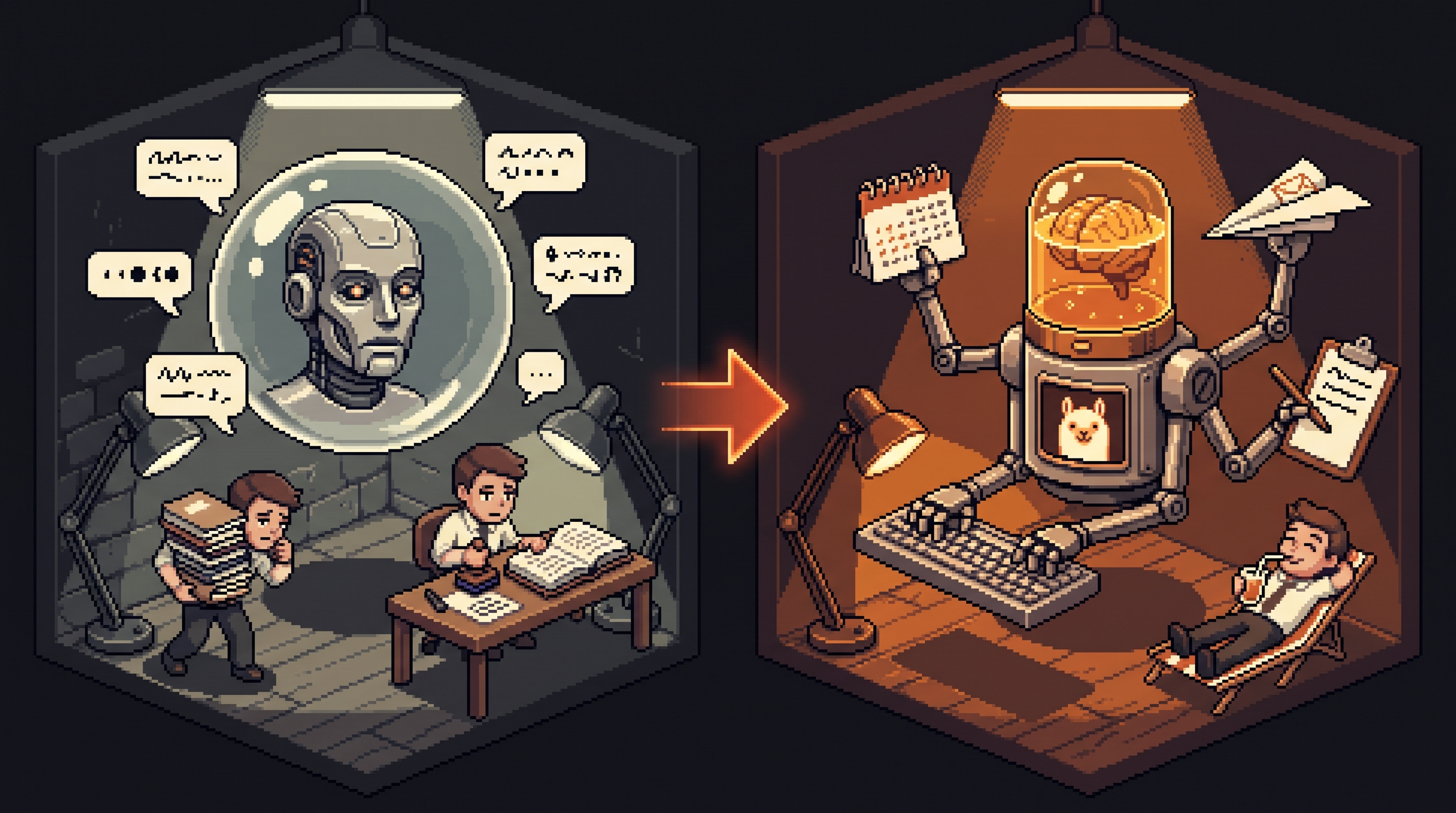
Let's fix that in plain English. If you take one sentence from this piece, make it this: a chatbot answers your question; an agent does your task. One is a conversation partner. The other is a digital employee you hand a goal to, and it breaks the goal into steps, uses tools, and finishes the job.
That difference sounds small. It's the difference between a dictionary and a staff member. This guide covers what an agent actually is, the three parts every agent has, what your first one could look like, and where the humans stay in the loop. (For which tasks deserve an agent, see the Rule-of-R piece; for building reliable ones, the loop-engineering guide. This one is the concept.)
An AI agent is a system that performs multi-step tasks autonomously toward a goal, instead of just answering questions. Where a chatbot waits for your next prompt and replies with information, an agent takes an objective ("organize my travel"), plans the steps, connects to other software through APIs — email, calendars, databases — executes each step, checks its own results, and continues until the goal is done. The core value shift: from discussing work to doing work, with humans setting goals and supervising.
Chatbot vs Agent: The One Table That Settles It
| Chatbot | Agent | |
|---|---|---|
| Mode | reactive — waits for your prompt | proactive — pursues a goal |
| Output | an answer | a completed task |
| Reach | text on a screen | other software, via API connections |
| Scope | one exchange at a time | multi-step, start to finish |
| Analogy | smart encyclopedia | digital employee |
| Ask it to book a flight | explains how, gives links | checks times, cross-references your calendar, emails the itinerary |
The flight example is the cleanest test. Ask a chatbot to book travel and you'll get a lovely explanation of how booking works, maybe some links. Ask an agent and it understands the goal involves several steps — check options against your calendar, pick, book, notify your team — and then performs them, one at a time, until the itinerary exists.
The word doing the heavy lifting is performs. Chatbots generate information that helps you do the work. Agents do the work so you don't have to.
The Three Parts of Every Agent
Strip away the branding and every agent is the same three components:
1. The brain — a language model
The intelligence (Claude, GPT-class models, or a local model running on your own hardware) that reads the goal, plans the steps, and decides what to do next based on what just happened. The brain is where judgment lives — which is also why brain quality determines agent quality.
2. The tools — its arms
A model alone is a brain in a jar; it can think about your email but can't touch it. Tools are the API connections that let the agent act on the world: send the Gmail message, write to the CRM row, post to the Slack channel, query the database. Each connection extends the agent's reach by one system.
3. The loop — its work ethic
The part that makes it an agent instead of a fancy single reply. The cycle:
goal given
  → do Step A
  → look at the result
  → decide: is Step B needed? was A even right?
  → adjust, continue
  → repeat until the goal is met (or a human is needed)
Without the loop, you have a chatbot with plugins. With it, the system checks its own work and corrects course — the property that lets it run without you watching every step.
One more component decides where the brain runs: local or cloud. A local model (say, via Ollama) makes the whole agent run on your hardware — relevant when the goal touches client data, internal documents, or anything you'd rather not ship to a third-party server. Public tools for low-stakes volume, local brains for sensitive work.
Your First Agent: The News Briefing
You don't need to be an engineer. Most modern platforms let you define an agent in plain English — the instructions are the programming. A realistic first build, the "morning briefing" agent:
agent: morning-briefing
goal: "every weekday at 8 a.m., I have a one-screen
       summary of news relevant to my industry"
instructions:
  - browse these specific sources (list them)
  - filter: keep only items about <your industry>
  - summarize each relevant item in two sentences
  - assemble one digest, most important first
  - send it to my email
tools_needed: [web_browsing, email_send]
Notice what happened there: nobody wrote code. The agent's job description is a bullet list. The human contribution is the judgment in the instructions — which sources, what filter, what "important" means — and the agent contributes the daily grinding through the steps.
That division holds for every agent you'll ever build: you supply the rules and the goal; the agent supplies the execution.
What Professionals Do With Them
Once the pattern clicks, the applications compound:
- Lead generation — an agent monitors sources for potential clients, checks each against your criteria, and writes qualified entries into the CRM, so your pipeline fills while you sleep
- Content distribution — one long blog post goes in; the agent produces five platform-native social posts and schedules each at its best time slot
- Research assistants — given a keyword, an agent reads across papers and news sources and compiles a cited report, with the sources it actually used
The common thread is autonomy under rules. Nobody watches these systems click through their steps; a human set the goal and the boundaries, and the agent handles the multi-hop journey between systems. (The trust ladder for granting that autonomy gradually — draft first, supervise, then schedule — is its own topic, and worth reading before you hand anything the send button.)
Where Humans Stay
Three permanent human jobs in any agent setup:
- Goal-setting — the agent optimizes for what you asked, so asking precisely is a skill
- Boundary-drawing — what it may never do (send to unknowns, touch money, delete) lives in rules, not hope
- Oversight — checking outputs at whatever cadence the trust level justifies, from every item to spot-checks
An agent isn't a replacement for judgment; it's an amplifier for it. The quality of what it produces tracks the quality of the instructions and boundaries it was given — which is why the humans who define agents well are worth more, not less, as the agents multiply.
Frequently Asked Questions
What's the main difference between a bot and an agent?
A bot (chatbot) is built for conversation and information retrieval — it answers. An agent is built for task execution — it takes a goal and completes the multi-step process to achieve it, usually through connections to other software. If the output is an answer, it's a chatbot; if the output is a changed inbox, calendar, or database, it's an agent.
Do I need to code to build an agent?
No. Most current platforms accept plain-English instructions as the agent's definition — role, goal, boundaries, tools. The skill that matters is instructional clarity: precise goals, explicit rules, and named tools. Programming-by-prompt still benefits from engineering thinking.
Can an agent replace an employee?
It can replace tasks, not the employee's judgment. Agents shine on repetitive, high-volume, rule-following work; they still need humans to define goals correctly, set boundaries, and supervise the logic. Teams that deploy agents well find the humans move up the stack, not out the door.
Is my agent's data safe?
Depends where its brain runs. Cloud models process your inputs on third-party servers; a local model (Ollama on your own machine) keeps everything in-house. Match the venue to the sensitivity — public research through cloud tools, client material through local ones.
Wrap-Up
An agent is the least mysterious thing in tech once the words land: a brain (model) with arms (tools) and a work ethic (the loop), aimed at a goal you set. Chatbots inform; agents perform. Start with one boring, repetitive, well-defined task — a briefing, a filter, a distributor — define it in plain English, keep the boundaries explicit, and supervise until it earns trust. You'll stop nodding along at the word "agent" and start deploying them.
Related posts
Loop Engineering: Build Your First Autonomous AI Agent
Stop being the loop between your ideas and the AI’s output. Define a verifiable goal, add a scheduled routine, and your first autonomous agent runs and stops itself.
Mastering Autonomous Workflows with Claude's /goal Command
Stop typing every instruction. Claude's /goal command hands the AI a finish line and a 5-part framework — Task, Why, Outcome, Constraints, Verification — so it works autonomously until the job is truly done.

The Responsibility Ladder: How to Move from Basic Prompts to Autonomous AI Work