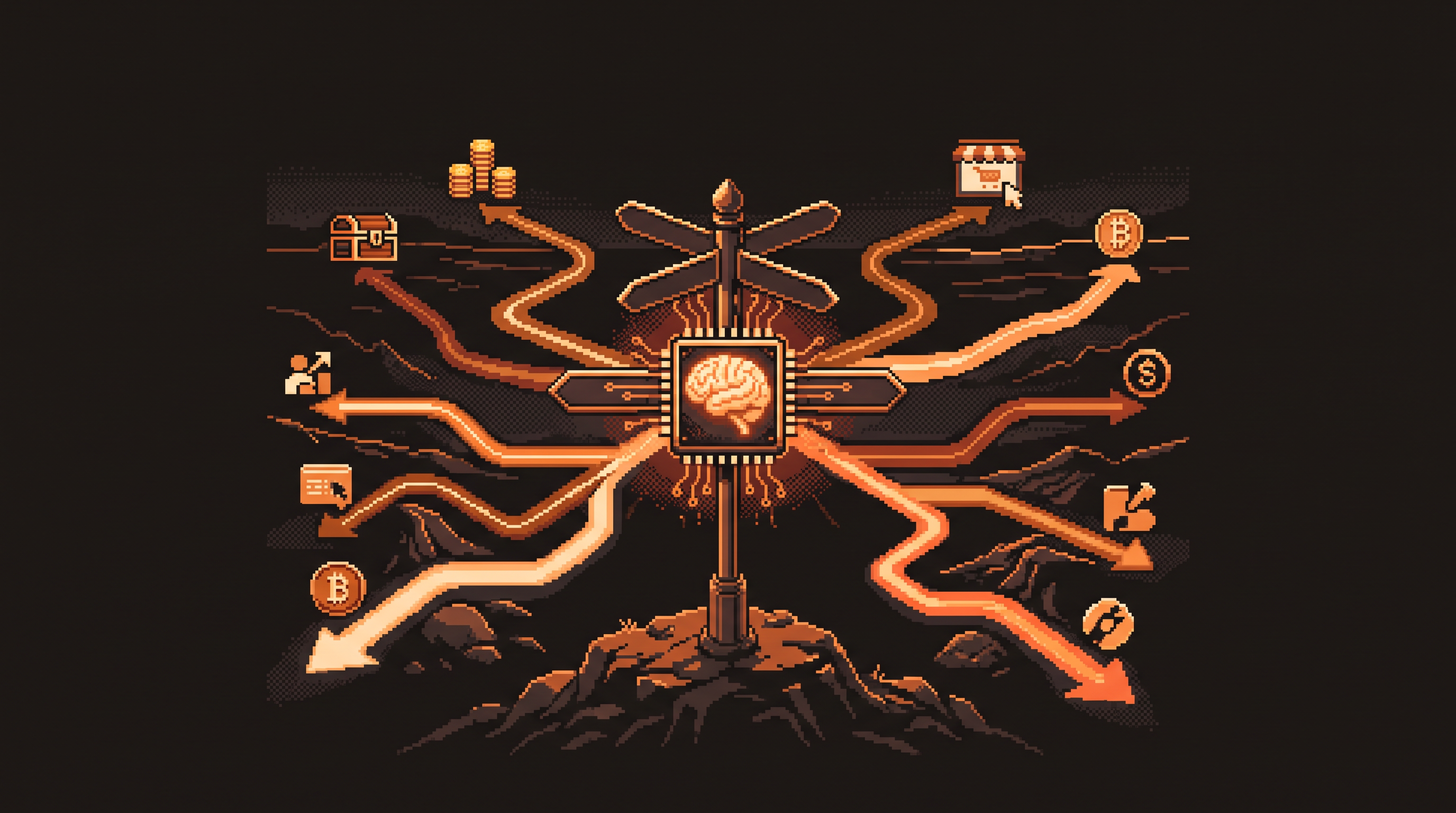
Most advice about making money with AI collapses into two camps: everything is about to be free money, or the whole thing is a grift. Neither helps you decide what to do on Monday.
Here's what the data actually says. PwC's 2026 AI Jobs Barometer puts the wage premium for workers with AI skills at roughly 62% across sectors, and the World Economic Forum sees advertised salaries about 23% higher for AI-skilled candidates. The skill gap is real, and someone is getting paid to close it. The useful question isn't "can AI make money" — it's "which of the actual paths fits my situation," because the twelve real ones vary wildly in speed, leverage, and what they demand from you first.
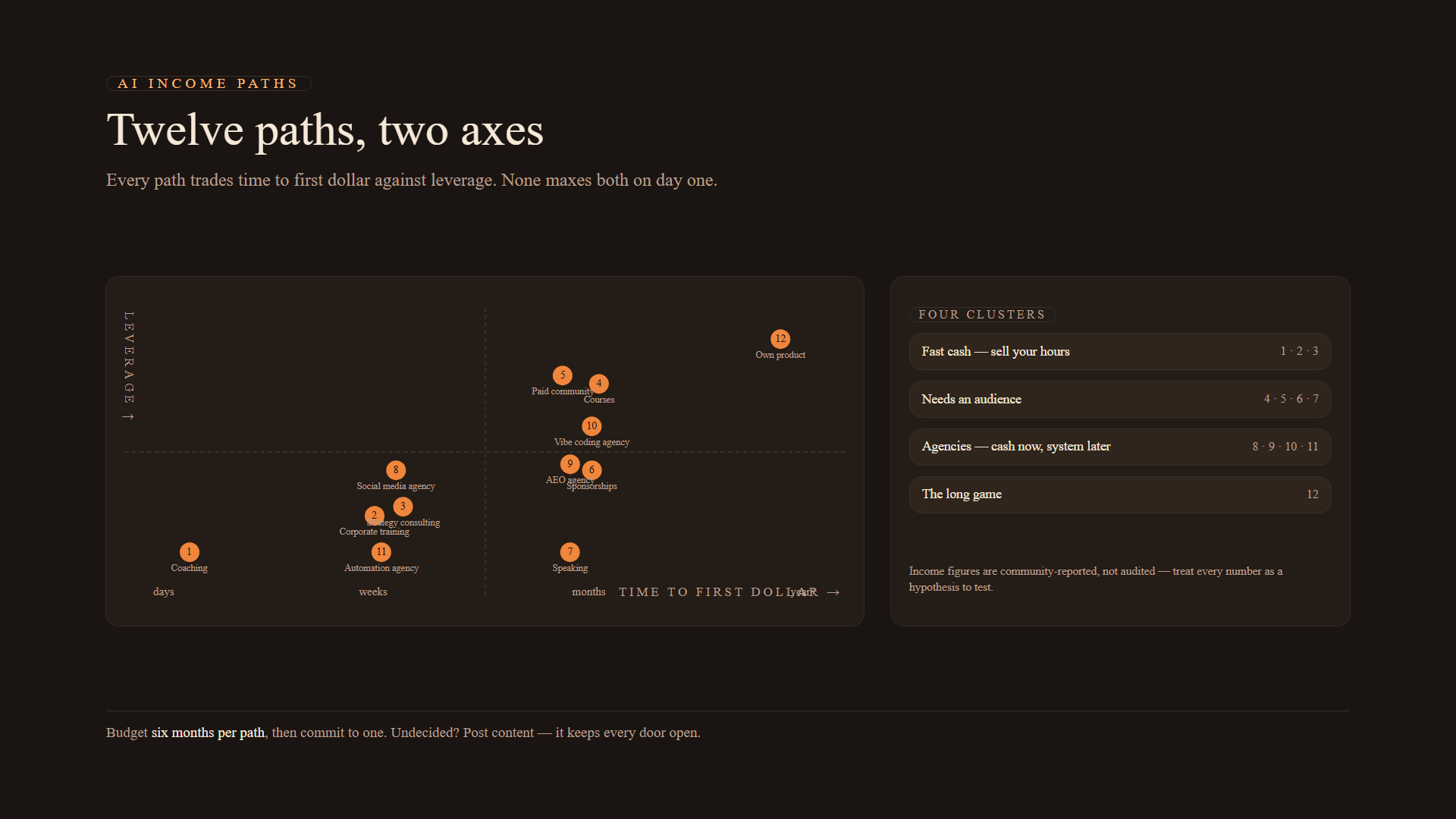
The twelve realistic ways to make money with Claude in 2026 sort by two axes: time to first dollar and leverage. Fastest cash is selling your hours — one-on-one coaching pays in days, corporate training and strategy consulting in weeks. Paths that need an audience (courses, paid communities, sponsorships, speaking) pay in months but scale. Agencies — social media, AEO, vibe coding, automation — are the best hybrid from zero because outreach funds you while delivery productizes. Your own product is the highest ceiling and the slowest first dollar, a year or more out. Budget six months per path, then commit to one.
Two axes decide everything
Hold two ideas at once, because every path trades one against the other:
- Time to first dollar — how many days or weeks until someone actually pays you.
- Leverage — whether income scales without your hours attached to it.
Fast cash means selling your time. High leverage means building an asset. The paths in the middle — mostly agencies — let you cold-outreach for cash today while productizing the delivery. There is no path that maxes both axes on day one. Anyone claiming otherwise is selling you a course about it.
The fastest cash: selling your hours
1. One-on-one AI coaching
The quickest money in the entire list, and the lowest ceiling. Your buyer is a busy professional — often in tech or middle management — who wants to become the "AI native" person on their team before the next promotion cycle. The offer is concrete: sit down together, build five reusable Claude skills that save them ten hours a week, starting with one painful recurring task like email triage.
A skill, in plain terms, is a saved set of instructions Claude runs on command:
# skill: meeting-summary-for-peak.yml
persona: |
  You summarize meetings for Peak: concise, action-first,
  no filler. Flag anything needing a decision.
inputs: [calendar, meeting-transcript]
rules:
  - "always end with: decisions, open questions, next actions"
  - "never invent attendees or dates"
Their bio plus their calendar plus a standing rule about how they want meetings summarized — build five of those and you've changed someone's week. Find these buyers wherever they already scroll, and in DMs. The catch is structural: you're trading hours for dollars, one at a time.
2. Corporate training for small and mid-size companies
Same skills as coaching, multiplied across a room. A company with employees has budget. Train ten people for five hours each and you've handed back fifty hours a week of capacity — an easy pitch for an owner who's worried about falling behind but doesn't want to run layoffs.
The distribution is where you win: local business groups, small-business associations, chambers of commerce. Local means almost no competition, because everyone else is fighting over the same LinkedIn feed. Roughly 70% of your curriculum recycles between clients, which makes this meaningfully more leveraged than coaching.
3. AI strategy consulting
You find the money; you build nothing. Walk into an established business, audit where hours and revenue leak, and hand over a short list of three to five automations worth acting on. Two leaks show up almost everywhere: inbound leads nobody called back, and customer support that answers in three days. Owners care about making money and saving time — speak only those two languages.
Realistic framing from operators who run this model: a mid-size operation with multiple teams can plausibly be losing 100 hours a week to manual work, and your fee prices against that number, not against your hours.
Paths that need an audience
4. Paid courses
Selling the same recorded course a thousand times is the classic leverage play — no extra work per sale. The failure mode is equally classic: people spend 99% of their effort building the course and 1% marketing it.
The course is the easy part. The marketing is the whole game.
Distribution runs through video-first platforms and comment-to-DM automations. If you have no audience yet, this path has a long runway before takeoff — a cost, not a flaw.
5. Paid communities
The math everyone quotes: $50 per month times 200 members is $10,000 per month, recurring. Segment by a demographic, a tool, or a skill level, and deliver weekly trainings, fresh skills, and accountability. The honest caveats matter more than the math: recurring revenue means recurring work, churn eats you without a steady stream of new material, and nobody joins an empty room. Start free, gate the best content, and treat this as a later move once an audience exists.
6. Brand sponsorships
AI and SaaS startups — especially funded ones — pay creators to film product demos. Reported rates: a channel under 10,000 subscribers pulls a few thousand dollars per video; larger channels $5,000 to $10,000, usually paid whether the video performs or not. Claude-related search volume is enormous right now, which makes it one of the friendlier niches to grow a channel in. The work is unglamorous: study what already performs, make your version, then cold email brands with your numbers and a rate card:
{
  "rate_card": [
    { "tier": "standard", "price": 1200, "deliverable": "one demo video + clips" },
    { "tier": "featured",  "price": 2500, "deliverable": "demo + dedicated post + newsletter mention" },
    { "tier": "series",    "price": 6000, "deliverable": "3-video series, metrics report" }
  ],
  "engagement": { "avg_views": "…", "ctr": "…", "avg_view_duration": "…" }
}
7. Paid speaking
A couple thousand dollars to $20,000-plus per talk for teaching hands-on AI workshops to non-technical rooms. It converts slowly: organizers want proof you're credible, prep time is heavy, and live demos punish you for every untested slide. What it buys, besides the check, is positioning that feeds every other path on this list.
Agency paths: cash now, system later
8. Social media agency for online businesses
One monthly strategy call, then an AI pipeline turns the call notes into 30 days of posts:
# monthly-content-pipeline.yml
input: strategy-call-notes
steps:
  - summarize: "30-day content plan from call notes"
  - batch: "write 30 posts in one run, 1 per day"
  - review: "human approves; no auto-publish"
  - schedule: "posts go out daily at 09:00"
output: 30 scheduled posts + 1 metrics recap
Your buyers are coaching programs and online businesses with revenue and a weak social presence. Medium leverage, quick cash, repeatable process. The friction is clients: onboarding, expectations, endless small tweaks. That babysitting is what makes $100K months harder here than they look from outside.
9. Answer engine optimization agency
Getting client businesses into the top results of both Google and AI answer engines. SaaS buyers want keyword rankings; local buyers still live and die by "plumber near me." The work: a base library of Claude SEO skills, tuned per client, wired into their site, repeated monthly. Agencies charge thousands per month, and the pitch survives when the fee is small against the ROI. Two warnings from practitioners: results are slow, and a lot of what gets sold as AEO is ordinary SEO with a new sticker. Learn the difference before you sell the difference.
10. Vibe coding agency
Your buyer is a non-technical founder with an 80%-built AI app, stuck on login, payments, or deployment. You finish and ship it. The pitch is speed and reliability, because startups die before they ship. Distribution works through AI and founder communities: give genuinely useful answers in public and the inbound comes to you. This is the highest-leverage agency path and also the one with a real prerequisite — you need enough hands-on skill with deployment, databases, and payments to be the person who finishes. With zero technical background, expect to learn for months first.
11. Automation agency for service businesses
Audit an established service business, then automate intake, follow-ups, reporting, and admin. Frequently called the easiest first client of the agency family, and honest operators call it the worst leverage: every business is messy, nothing talks to anything, and nobody has been seen running a $100K-per-month solo operation in this lane. If you try it, note that freelance platforms are underrated: most applicants clearly never read the posting, so reading it puts you in the top decile.
The long game
12. Build your own product
The highest ceiling and the slowest first dollar. A small SaaS that does one job, priced monthly, where adding a user costs you nothing — no onboarding calls, no sales meetings. Successful small products at $1M a year in revenue have sold in the $5M to $20M range. The brutal stretch is the climb to the first $10K MRR, and the design rule that keeps climbers alive: a new user should get the product's core value inside 90 seconds of signing up. Don't pick this path if you need money this quarter.
The full map at a glance
| # | Path | First dollar | Leverage | Prerequisite |
|---|---|---|---|---|
| 1 | Coaching | Days | Low | Working skill with Claude |
| 2 | Corporate training | Weeks | Low to mid | Same, plus a room presence |
| 3 | Strategy consulting | Weeks | Low to mid | Pattern recognition for waste |
| 4 | Courses | Months | High | An audience |
| 5 | Paid community | Months | High | An audience, ongoing output |
| 6 | Sponsorships | Months | Mid | A grown channel |
| 7 | Speaking | Months | Low | Credentials and reps |
| 8 | Social media agency | Weeks | Mid | One strong repeatable process |
| 9 | AEO agency | Months | Mid | Real SEO understanding |
| 10 | Vibe coding agency | Months | Mid to high | Shipping ability |
| 11 | Automation agency | Weeks | Low | Tolerance for messy clients |
| 12 | Your own product | A year or more | Highest | An idea worth 90 seconds |
Income figures in this space are mostly community-reported rather than audited, so treat every number here — including the ones above — as a hypothesis to test, not a promise.
How to choose without stalling
Experiment, but with a deadline. Roughly six months per path, then commit to one. Splitting your energy across five paths is how people stall below $100K per month for years: every path needs depth, and depth needs focus. The agencies are the best hybrid for most people starting from zero, because cold outreach pays this month while the delivery system compounds. If you genuinely have no idea where to start, post content about what you learn — it's the only path that preserves every other option while costing nothing but consistency.
And keep the timeline honest. These are months-to-years arcs. The people still standing in year two are the ones who picked a path they could enjoy on the days it was boring.
Key takeaways
- Sort every opportunity by time to first dollar and leverage before comparing anything else.
- Fastest cash: coaching and local corporate training — start this week if you need money this month.
- Best hybrid from zero: an agency, where outreach funds you while you productize delivery.
- Highest ceiling, longest road: your own product. Only with a financial cushion.
- Budget six months per experiment, then commit to one path.
- If undecided, publish content. It keeps every door open.