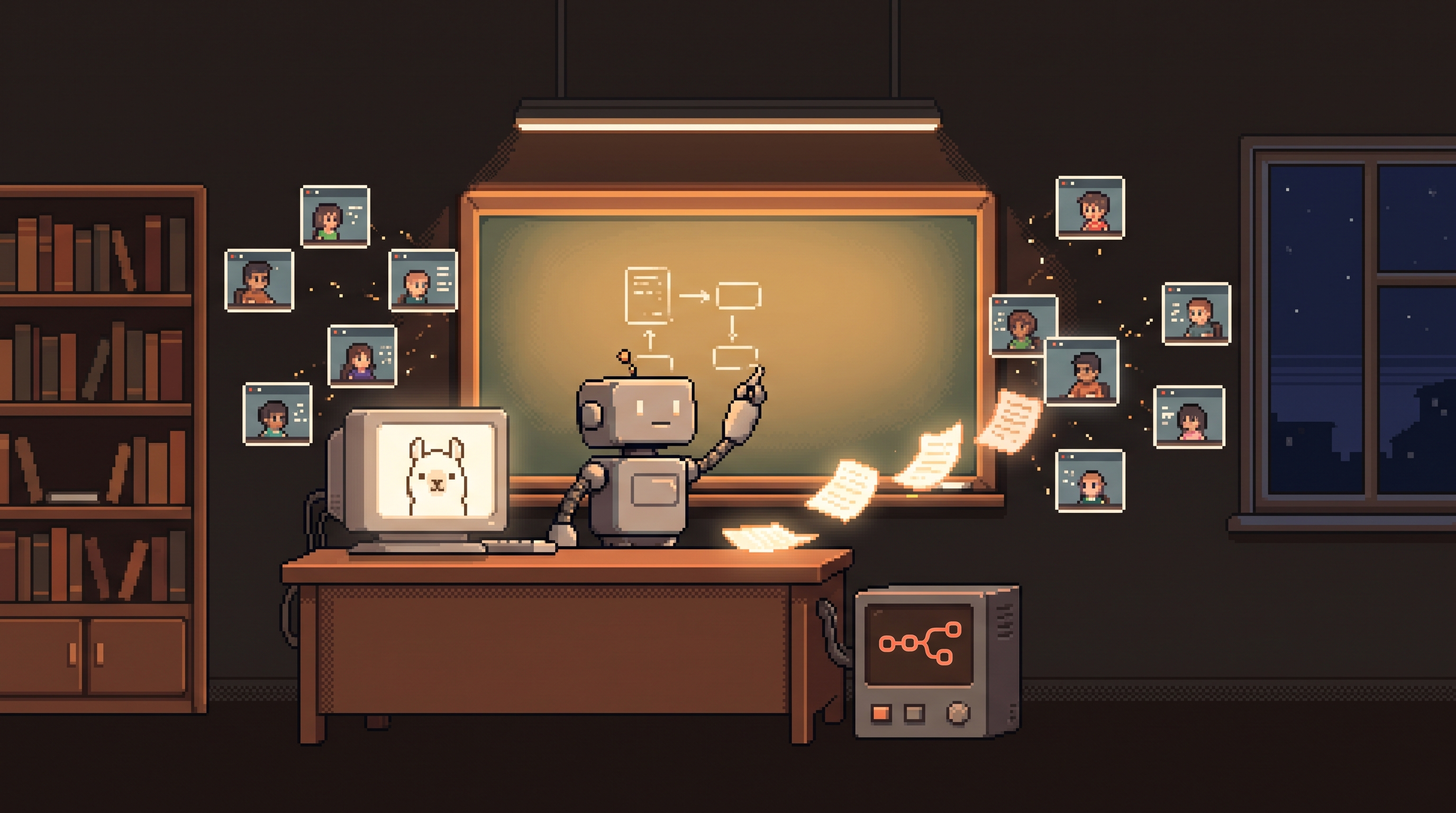
Teach Once, Reach Thousands: Scale What You Know with a Local AI Content Engine
You explained the same thing five times this week. Once to a colleague who got stuck. Once to a client over chat. Once in a forum thread. Once in a DM. And once more, from memory, to yourself six months from now — because you already forgot the fix. Every one of those explanations evaporated the moment it ended.
Teaching one person at a time doesn't compound. But there's a version that does: turn what you know into content, and let a small AI-assisted pipeline multiply each lesson into every format your audience consumes. This guide shows the model, the honest economics, and the exact local-first setup — Ollama for drafting, n8n for routing — that turns one solved problem into a teaching library that works while you sleep.
Content creation scales knowledge by moving teaching from a one-to-one model to a one-to-many model. Instead of explaining a fix to each person who asks, you document it once, and an AI-assisted pipeline repurposes that single note into a blog post, a video script, a newsletter issue, and a chat digest. Local AI (Ollama) drafts and reformats at zero marginal cost, n8n routes each version to the right channel, and every piece becomes a permanent library entry. One hour of writing keeps teaching people for years.
The One-to-One Trap
Traditional teaching is linear. One teacher, one student, one hour. The hour is spent, the knowledge transfers once, and the teacher has nothing left to show for it.
Most technical people still work this way, even in 2026:
- A teammate asks how the deployment works — you explain for 30 minutes on a call.
- A client hits the same error every month — you type the same answer into email.
- A stranger asks in a community — you help once, and the thread disappears.
None of it compounds. It's honest, generous work — but it's also a leak. The fix you gave away five times could have been a document that gives itself away five thousand times.
Think of it like cooking. Cooking a great meal for one guest is one-to-one: the effort dies with the dinner. Writing down the recipe is one-to-many: the effort repeats itself every time someone follows it. Content is the recipe, not the meal.
The One-to-Many Machine
Social platforms and blogs are the largest teaching machines ever built, and not only because of reach. Three properties do the heavy lifting:
- Presence-free teaching. A written or recorded lesson teaches whether you're awake, employed, or on vacation. Your presence is baked in once.
- Compounding reach. Search and platform distribution send new learners to a two-year-old post without you lifting a finger. Old content keeps recruiting new students.
- A permanent library. Every published lesson stacks. Fifty notes become a course-shaped archive that no live workshop can match.
The goal isn't fame. It's leverage: the moment your knowledge lives in a library instead of your head, the number of people you can teach stops depending on your calendar.
Why AI Changed the Economics
The old objection was real: producing content in four formats takes four times the work. That's exactly the part AI collapsed.
- Drafting got cheap. A local model via Ollama rewrites a technical note into a beginner tutorial, a script, or a newsletter draft in seconds, on your own machine.
- Formatting got free. Turning one markdown file into a post, an email, and a chat digest is a script, not a job.
- Distribution got automatic. An n8n workflow can watch a folder and publish each finished piece to the channels you choose.
Here's the honest comparison of the three teaching models:
| One-to-one teaching | Hand-made content | AI content engine | |
|---|---|---|---|
| Time per lesson | repeats every time | written once, heavily edited | written once, AI repurposes |
| Cost per extra student | your hour (~$0 marginal otherwise) | near zero | near zero |
| Formats covered | one conversation | usually one | post + script + email + chat |
| Compounds over time | no | yes, slowly | yes, every format feeds it |
| Privacy of your notes | n/a | full (if local) | full (local AI, self-hosted) |
The engine doesn't write better than you. It multiplies what you write. You still supply the thing that matters — the actual solved problem and the judgment about what's true.
The Engine: One Problem, Five Formats
The pipeline has four stations. Each one is small; together they're a teaching machine.
Step 1: Capture the Problem Where You Solve It
The raw material isn't inspiration — it's the fix you just finished. Keep a plain markdown note next to the work:
{
  "problem": "n8n webhook returns 401 after token rotation",
  "context": "self-hosted, behind Caddy, tokens in .env",
  "fix": "re-read env at workflow start; documented the exact steps",
  "audience": "solo operators self-hosting n8n"
}
Write it while the pain is fresh. Five minutes, no polish. This note is the seed everything else grows from.
Step 2: Repurpose with Local AI
Feed the note to a local model and ask for the formats your audience actually consumes. With Ollama this stays on your machine:
ollama run llama3.2 "Rewrite this fix note as a beginner-friendly
tutorial with a hook, numbered steps, and one common mistake.
Keep every technical detail exact. Note: $(cat notes/webhook-401.md)"
Or scripted for reuse across every note you collect:
import { Ollama } from "ollama";

const ollama = new Ollama({ host: "http://localhost:11434" });
const note = await Bun.file("notes/webhook-401.md").text();

const formats = [
  "blog post with a concrete opening problem",
  "60-second video script in plain spoken English",
  "newsletter section under 150 words",
  "Telegram digest under 400 characters",
];

for (const f of formats) {
  const res = await ollama.chat({
    model: "llama3.2",
    messages: [{ role: "user", content: `Turn this fix note into a ${f}. Keep all technical facts exact: ${note}` }],
  });
  console.log(`=== ${f} ===\n${res.message.content}`);
}
Your job shifts from writer to editor: you check facts, delete hallucinations, and keep your voice. That's the quality gate, and it's non-negotiable.
Step 3: Route with n8n
A self-hosted n8n workflow watches your notes folder and moves finished drafts where they belong:
trigger:
  type: file_watcher
  folder: /peak/teaching/notes
steps:
  - repurpose_via_ollama
  - save_drafts: { post: blog/drafts/, script: video/scripts/, email: newsletter/queue/ }
  - notify: { channel: telegram, message: "New draft ready for review" }
publish_rule:
  requires: manual_approval
  on_approve: [publish_post, queue_newsletter, post_telegram_digest]
Everything is gated behind manual approval. Automation moves the paper; you decide what ships.
Step 4: Deliver Where Learners Already Are
The same lesson lands in four places without four efforts:
- Blog — the permanent, searchable library entry.
- YouTube script — the explanation people watch when they won't read.
- Newsletter — the version that arrives where attention already is.
- Telegram channel — the short digest for the people who live in chat.
Each format is a door into the same room. More doors, more students, still one lesson.
Make It Practical, Not Theoretical
Educational content earns trust when learners can act on it immediately. For every lesson:
- Show the exact command, config, or prompt — copy-paste ready, not described in the abstract.
- Include the failure you hit first, not just the clean ending. Errors teach more than success.
- End with one next step a beginner can finish today.
Observation doesn't scale knowledge. Application does. The best "teaching machine" output ends with the learner's hands on the keyboard, not with a nod of agreement.
Frequently Asked Questions
Is content creation only for marketing and personal branding?
No. Marketing is one use, but the deeper function is scale: content moves teaching from one-to-one to one-to-many, so a single explanation keeps working after the conversation ends. The marketing is a side effect of the teaching, not the point of it.
Do I need a big audience before this is worth it?
No. The library compounds from day one. A post written for ten readers this month is the same post that serves a thousand searchers next year. Audience size changes how fast the library pays out, not whether it builds.
Can a local AI model really write usable teaching content?
For drafting and reformatting, yes — especially when you feed it your own technical note and demand exact facts. It struggles with original expertise and fresh accuracy, which is why the human edit pass stays in the loop. Treat it as a fast, private junior editor, never as the author.
How is this different from just blogging more?
Blogging more is a volume strategy for one channel. An engine is a reuse strategy: one captured problem automatically becomes several formats, delivered on a schedule, with your review as the only manual step. You write the lesson once — the system handles the multiplication.
Related posts
One Channel, Done Well: Finding Where Your Audience Actually Lives
Stop splitting your energy across five platforms. A scorecard for finding the one channel where your audience actually lives.
The 100% AI Handoff: My Start-to-Finish Content Strategy (Every Prompt Included)
I stopped producing content and started owning it. The full pipeline that researches, writes, illustrates, publishes, distributes, and films every post — with every prompt ready to copy.
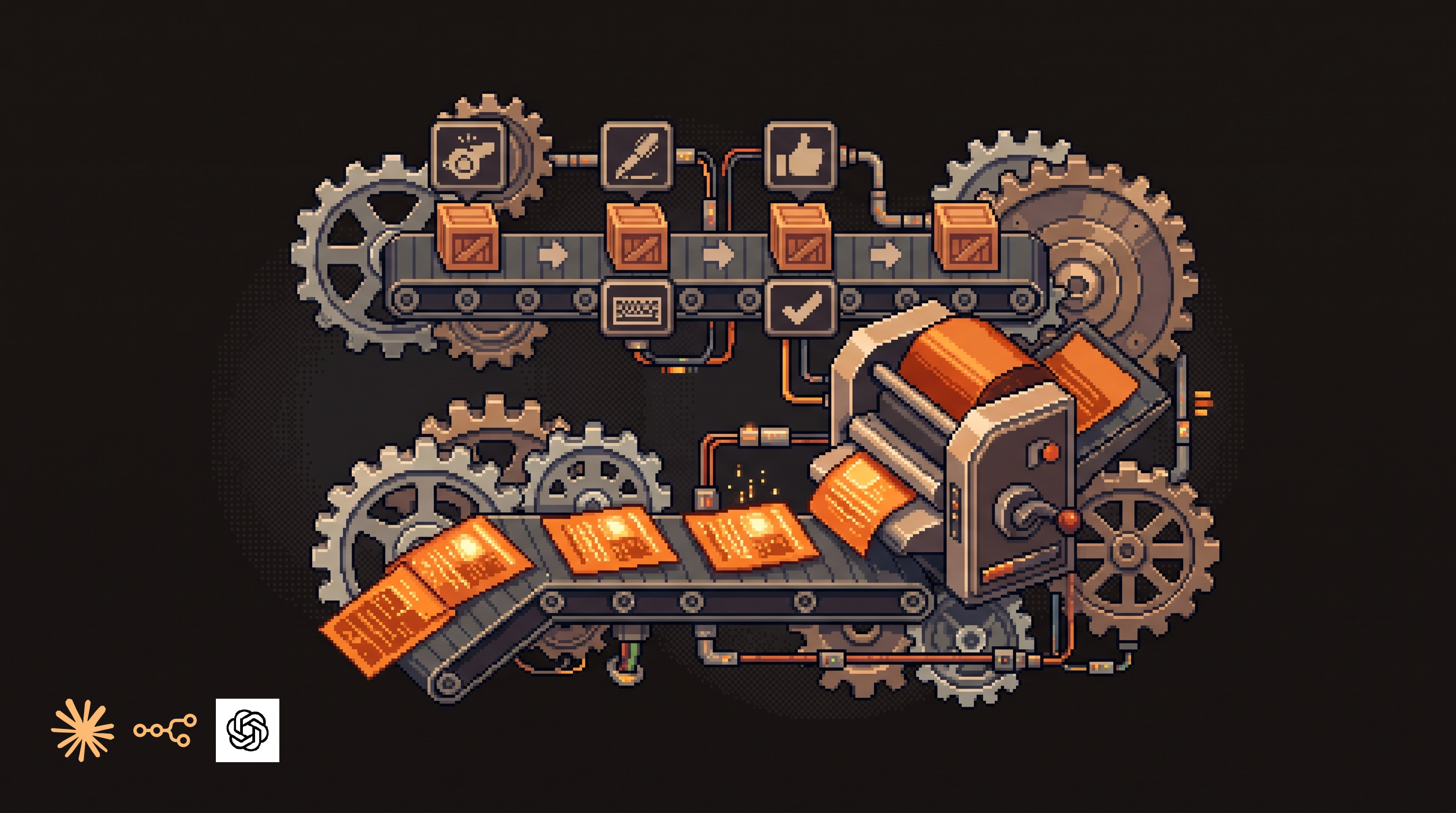
Build an AI Social Media Content Pipeline: Coach, Writer, Grader, Scheduler
Stop hand-posting every day. A brand brief, five focused AI skills, a grading rubric, and a scheduler turn one idea into a week of platform-tailored, quality-checked posts.