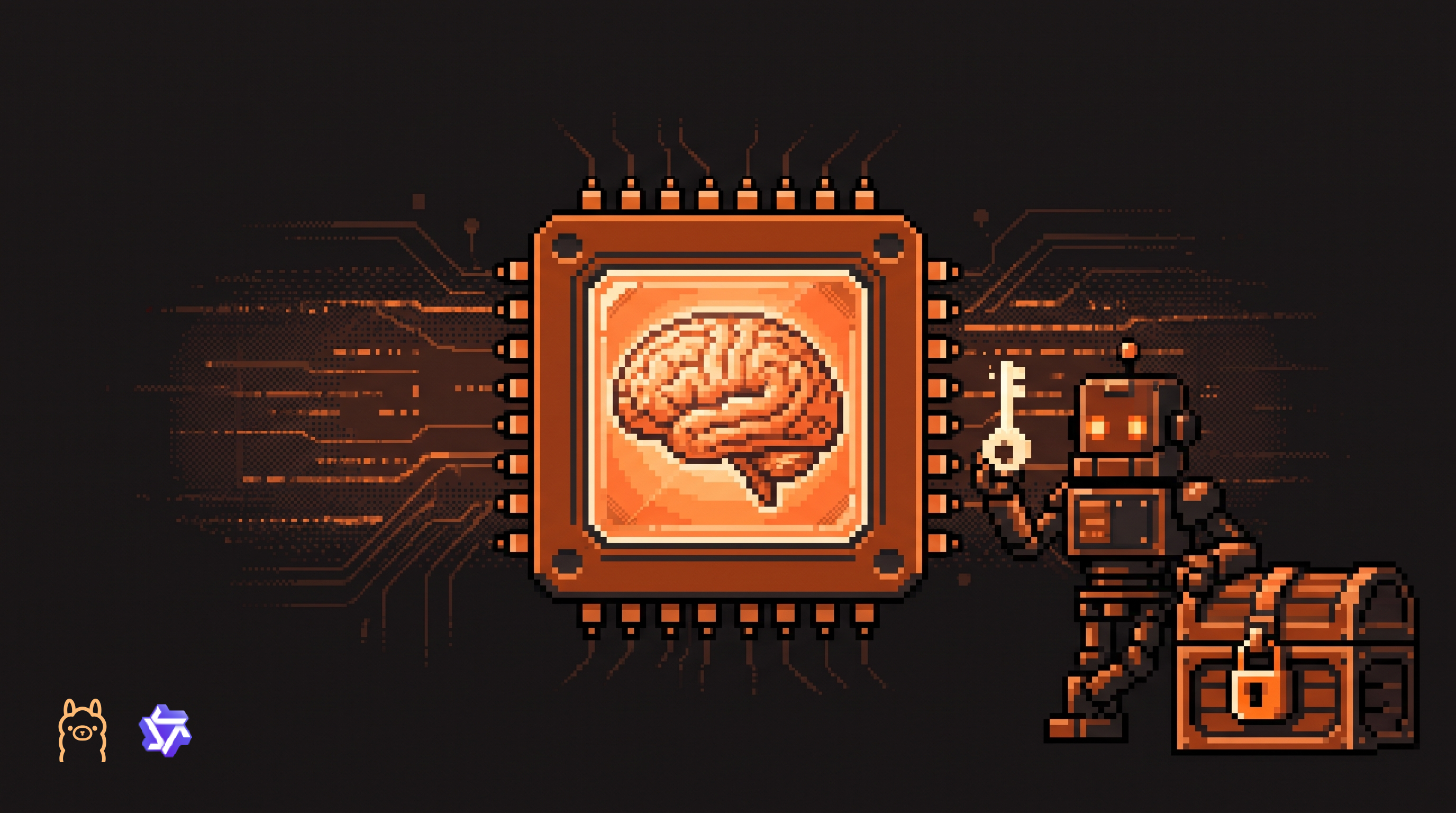
An editor at XDA recently tried an experiment most of us assume we know the answer to. He took a reverse-engineering task — the kind of job he would normally send to a frontier cloud model like Claude or GPT — and gave it to Qwen 3.8 27B running locally instead.
The mid-size model finished the job in about 30 minutes. Not a toy task, not a summary — real analysis of an unknown binary, and the output was good enough that he described himself as genuinely shocked.
That result is worth paying attention to, because it marks the boundary of "local AI is only for chatbots and drafts" moving again — this time into territory people reserved for the biggest cloud models.
Qwen 3.8 27B, a mid-size open-weight model, completed a reverse-engineering analysis job on local hardware in roughly 30 minutes — a task class normally assigned to frontier cloud models. It identified the target's structure and reconstructed meaningful logic without any data leaving the machine. The practical takeaway: serious code-analysis work no longer automatically requires a cloud API, which matters most when the code is private, sensitive, or under NDA.
What the experiment actually involved
Reverse engineering is a good stress test for a language model because it stacks several hard skills at once:
- Reading unfamiliar structure. No docs, no comments — just the artifact as it is.
- Pattern recognition across layers. Recognizing compiler signatures, frameworks, and conventions that hint at how a piece of software was built.
- Reasoning under uncertainty. Filling gaps with hypotheses, then checking them against evidence in the artifact.
- Long sustained attention. Holding a mental map of the target while working through it piece by piece.
A model that can do all four is doing something much closer to engineering than to autocomplete. That is why the XDA result stings a little for anyone (including me) who has been reflexively reaching for a frontier cloud model for this class of work.
Why the model size matters more than the headline suggests
27B is the interesting middle of the model world right now:
- Small models (7B–14B) are fast and cheap to run but routinely fall apart on multi-step technical reasoning.
- Frontier models are brilliant but cloud-only, metered per token, and see everything you paste.
- Mid-size models in the 20–30B range run on a single high-end consumer GPU, keep data local, and — as this test shows — are now crossing into genuinely hard analytical work.
The gap between "local model" and "serious model" has been closing for a while. Tests like this one are how you actually notice it has closed for your kind of work.
The privacy angle is the real story
For hobby projects, a cloud API is convenient. But reverse engineering and deep code analysis often involve exactly the material you should not paste into someone else's API:
- Client binaries under NDA
- Security research with disclosure constraints
- Internal tooling and proprietary logic
- Anything where "the data left my machine" is itself the failure
A model like Qwen 3.8 27B running through Ollama or SGLang on your own box removes that entire category of risk. No per-token cost, no retention policy to read, no vendor terms to interpret. For a business handling sensitive systems — which is most businesses — that is not a nice-to-have. It is the requirement the cloud models fail by default.
What to expect if you try this yourself
A realistic picture, based on where mid-size models genuinely sit today:
| Expect | Don't expect | |
|---|---|---|
| Speed | Fast iteration on a single GPU | Instant — long analyses still take tens of minutes |
| Quality | Solid structural analysis, good hypotheses | Perfect, verification-free output |
| Coverage | Most common frameworks and build patterns | Obscure or heavily obfuscated targets solved unaided |
| Cost | Hardware you may already own | Zero human review |
The workflow that works is the same one that works with frontier models: let the local model do the first 80% — mapping structure, flagging patterns, drafting hypotheses — and keep the verification loop human. What changed is that the first 80% no longer requires sending your most sensitive artifacts to a third party.
How this fits a local-first AI stack
This is the pattern I keep seeing across local AI work, and it is bigger than one benchmark:
- Task classes migrate down. Every model generation moves some "needs the cloud" job into the run-locally tier. This round: deep code analysis.
- Hardware you own becomes more capable without upgrading. The same 24GB GPU that ran chatbots two years ago now runs an analyst.
- Automation gets safer to point at real problems. An n8n flow or agent pipeline that calls a local model can safely touch private repos, client files, and internal systems — because the model never phones home.
If you are building AI workflows for a business, that third point is the one to sit with. The bottleneck on automating sensitive work was never just model quality — it was where the model lived.
Should you switch your analysis work to a local model?
Not wholesale. Use the split that matches the sensitivity and difficulty of the task:
- Public, generic problems — any capable model is fine, cloud convenience wins.
- Private but routine analysis — a mid-size local model like Qwen 3.8 27B is now genuinely competitive.
- Maximum-difficulty frontier work — the biggest cloud models still hold an edge, but test local first; you may be surprised how often it is enough.
The XDA experiment is one data point, but it is the kind of data point that should change your defaults. "Local model" no longer means "compromise." Increasingly, it means the analysis happened on your machine, on your schedule, with your data still in the building.
Source: XDA — "I gave Qwen 3.8 27B a reverse-engineering job I assumed needed a frontier model, and it finished in 30 minutes."
Related posts
Structured Prompting: Why Sequences Beat Single Prompts
Same model, different results — the difference is process. Frame with a persona, build one deliverable per step, critique under a hostile role, then write the sequence down until it becomes automation.
Why AI Agrees With Everything You Say (and How to Make It Stop)
The AI isn’t lying to you — your prompt is telling it what to say. Audit your questions, flip premises, and assign hostile reviewers to turn a yes-machine into an honest critic.
9 AI Skills That Turn Chat Into Business Systems
The difference between an idle AI subscription and a working teammate is nine learnable skills: ask-first habits, real context, feedback loops, SOPs, and agents that act across your apps.