
An AI assistant that worked beautifully in a demo can fall apart in production in three predictable ways: latency that spikes the moment traffic gets serious, function calls that break as conversations grow long, and data-retention terms vague enough that legal won't sign off on the whole project.
None of these are model-quality problems. They're architecture problems — and they have known fixes. Here's how to deploy agent-ready LLMs to the cloud so tool calls stay reliable across long contexts, responses stay fast under load, and privacy holds by default rather than by promise.
Deploy agentic LLMs to the cloud with a five-part architecture: a warm, region-pinned model runtime; a tool orchestrator that validates and executes structured function calls; a context store feeding retrieval instead of flooding the prompt; a policy layer enforcing zero retention, redaction, and no-training guarantees; and full observability. Keep latency low with warm pools, co-located tools, and streaming. Keep function calling reliable with strict schemas, state summaries, and dry-run validation. Escalate reasoning effort (low/high/max) only when confidence tests demand it.
What "agentic" means in practice
An agentic LLM coordinates multi-step actions: calling external tools, making API requests, reasoning over memory or long documents, and controlling subprocesses. Four capabilities make that work in production:
- Deterministic tool calling — the model reliably emits structured calls your orchestrator can execute.
- Multi-step planning — plans are generated and revised across turns while state persists.
- Context persistence — long histories don't silently drop important facts.
- Configurable reasoning effort — you can trade response time for deeper deliberation on demand.
Each of these changes how you design the runtime and the monitoring around it — a single-turn text completion this is not.
The core architecture
| Layer | Job | What it decides |
|---|---|---|
| Model runtime | Cloud-hosted LLM, autoscaled, kept warm | Region for compliance + latency; model variant |
| Tool orchestrator | Executes the model's structured calls | Retries, rate limits, auth, dry-runs |
| Context store | History, embeddings, retrieval indexes | What the model sees vs. what's stored |
| Policy & privacy layer | Retention rules, redaction, audit | What leaves, what's logged, what's dropped |
| Observability stack | Latency, tokens, tool-failure rates | When to alert, rollback, or escalate |
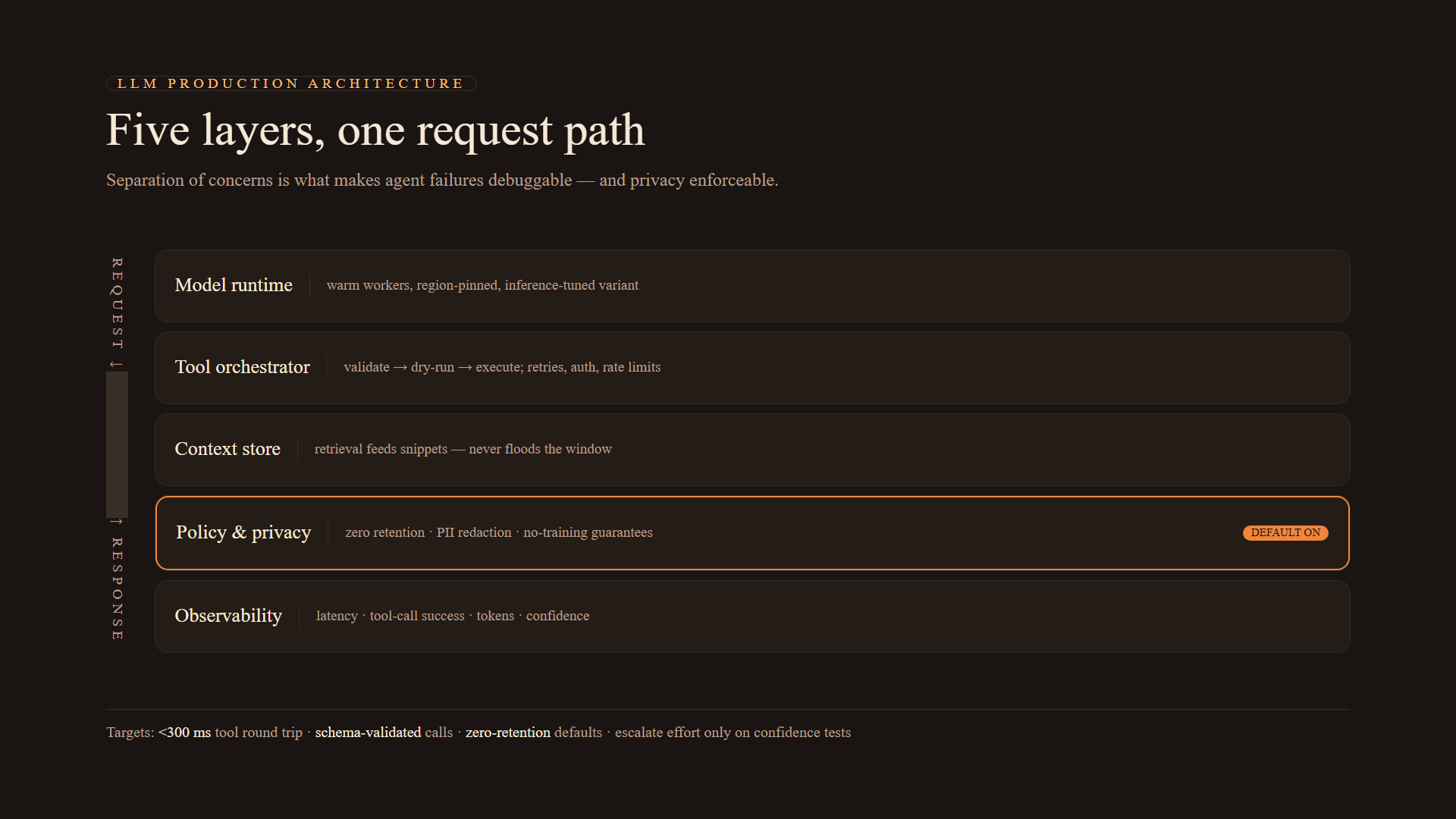
Separation of concerns is the point. When a tool call fails, you know it's the orchestrator. When latency creeps, it's the runtime or the network path. When a privacy question lands, the answer lives in one layer, not scattered across your stack.
Delivering low latency at scale
- Warm pools — keep hot model workers to avoid cold starts; hold minimum concurrency for bursty workloads.
- Model selection — smaller inference-tuned variants often beat bigger models for interactive agents.
- Batching vs. dedicated threads — batch background jobs; give interactive sessions dedicated workers.
- Edge ingress — regional entry points cut round-trip time for distributed users.
- Tool co-location — host frequently-used tools and caches in the same network zone as the runtime.
- Token streaming — stream partial output so perceived responsiveness survives long generations.
The practical target: a simple tool-call round trip under 200–300 ms, achieved by co-locating tool endpoints and keeping workers warm.
Reliable function calling across long contexts
Function calling degrades when the model must reference many prior messages or large documents. Six techniques hold it together:
- Explicit schemas — strict typed schemas (JSON Schema or protobuf) for arguments make parsing robust:
{
  "name": "fetch_document",
  "description": "Fetch a document by ID for summarization",
  "parameters": {
    "type": "object",
    "properties": {
      "doc_id": { "type": "string", "pattern": "^doc_[a-z0-9]{8,}$" },
      "sections": { "type": "array", "items": { "type": "string" } }
    },
    "required": ["doc_id"],
    "additionalProperties": false
  }
}
- Tool metadata near the top — concise canonical signatures in-context so the spec is always visible.
- Chunking + retrieval — store long documents in a retrieval system; feed only relevant snippets.
- Turn-level state tokens — carry a short structured summary (
task_queue: 3 pending, last_tool: fetchDocs(id=123)) instead of replaying full tool outputs. - Post-parse validators — check outputs before execution; on failure, ask the model to correct with a one-shot hint rather than running a malformed call.
- Idempotent tools — retries must be safe: transaction markers, dedup IDs.
The safe loop: model emits a call → backend validates and dry-runs it → valid executes, invalid bounces back with a correction hint.
The reasoning-effort knob: low / high / max
Most production runtimes expose a deliberation-depth control. Map it to stakes, not vibes:
| Level | Behavior | Use for |
|---|---|---|
| Low | Fast single-pass | Routine chat, search, lookups |
| High | Extra internal passes, more deterministic decoding | Report generation, synthesis |
| Max | Multi-step planning, multi-turn orchestration | Financial decisions, deployment scripts |
Default low; escalate only on explicit user request, detected low confidence, or a policy trigger (say, transactions above a threshold):
# escalation-policy.yml
default_effort: low
escalate_when:
  - user_requests_deep_analysis
  - confidence_score_below: 0.6
  - policy:
      rule: transaction_amount_above
      threshold: 1000
      action: max_effort_plus_human_review
cost_guardrail: alert_when_tokens_per_session_exceeds: 50000
Measure cost against marginal utility — max effort burns compute and lengthens output, so earn it.
Privacy by default, not by press release
Privacy-by-default is both a runtime configuration and an organizational commitment — technical measures must be paired with policy, audits, and contractual assurances.
- Zero retention — ephemeralize inputs immediately after processing unless persistence is explicitly permitted.
- No-training guarantees — contracts and runtime flags that user inputs never train future models.
- Regional hosting — models and logs pinned to regions that satisfy data-residency rules.
- Redaction/tokenization — automated PII scrubbing before anything reaches the model.
- Minimal audit trails — access-controlled incident logs without raw user content.
- Encryption — TLS in transit, disk-level at rest, no exceptions.
# privacy defaults
retention: zero                # drop inputs post-processing
training_use: forbidden
hosting_regions: [us, eu]      # match residency requirements
pii_redaction: before_model    # scrub prior to inference
audit_logs: minimal            # metadata only, no raw content
One trade-off to plan for: zero retention means no organic training data. Budget for synthetic or consented datasets for future model updates.
Observability and testing
You can't manage what you don't measure:
- Latency — end-to-end and per component (inference vs. tool time).
- Function-call success rate — percent of emitted calls that validate and execute.
- Token usage and cost — per session, bucketed by reasoning-effort level.
- Confidence signals — calibration metrics, not just vibes.
- Safety-filter rate — flags plus false-positive rate.
Before production: unit-test schemas with randomized valid/invalid payloads, load-test warm pools under realistic concurrency, run adversarial prompts against redaction, and simulate long-context sessions to verify plan persistence.
A worked request, end to end
- User asks for something multi-step: fetch documents, summarize, call an external API.
- The orchestrator stores the request and runs a low-effort planning pass to split sub-tasks.
- The model returns a structured plan; every call validates against its schema.
- The backend executes the first tools, summarizes results into a compact context blob, and returns blob + next step.
- For final verification the model requests escalation; a max-effort pass rechecks critical fields.
- The answer streams to the user with a provenance record (timestamps, call IDs) — raw inputs omitted where privacy rules require it.
The deployment checklist
- Runtime region satisfies residency and latency needs.
- Model variant optimized for inference, not maximum parameter count.
- Strict function schemas plus in-run validators.
- Retrieval system and state summarizer — no context flooding.
- Warm pools and autoscaling configured.
- Retention and training flags enforce zero retention.
- Latency, tool success, and token usage instrumented.
- Escalation policies for effort and human-in-the-loop review.
- Load, safety, and adversarial tests passed.
Higher effort costs compute; strict validation costs an occasional extra round-trip; zero retention costs training data. All three are worth it — they're the price of an agent you can trust in production. Instrument everything, escalate deliberately, and keep the privacy layer boring. Boring is what reliable looks like.