
Most teams that "have an AI team" actually have a handful of chatbots all doing approximately everything. Ask who's responsible for a bad output and the answer is a shrug. Results wobble, effort gets duplicated, and every mistake is a fresh surprise.
A real AI team looks less like a group chat and more like a manufacturing line: role-specific agents, each with one job, handing structured work to the next station — plus an independent quality gate between creators and finalization, and a lessons loop so the same failure never ships twice.
Here's the blueprint: what each agent does, the data contracts between them, how the Checker works, and the order to launch things in.
Build an AI agent team as a pipeline of single-responsibility agents — Scout (discovery), Writer (drafting), Closer (execution), Operator (orchestration), Accountant (cost tracking) — plus an independent Checker that grades outputs against a rubric and a Lessons System that converts failures into prompt and rule updates. Never let an agent grade its own work. Handoffs use strict JSON schemas with provenance, and automation is switched on only after pass rates and Checker agreement clear your thresholds.
Why single-responsibility agents beat generalist bots
When each agent owns exactly one function, you get:
- Clear failure modes — debugging points at a station, not the whole system.
- Modular cost control — expensive agents run only when needed.
- Clean improvement data — errors are isolated, so lessons attach to a cause.
- Real audit trails — "who did what" is explicit in the handoff metadata.
And one rule above all: no agent grades its own work. Self-assessment bakes in bias and hides slowly degrading quality. An independent Checker always sits between a creator and finalization.
The seven components
| Agent | One-line job | Key output | Watch these metrics |
|---|---|---|---|
| Scout | Find and triage leads, topics, opportunities | Structured item with priority + confidence | Recall, precision, time-to-discovery |
| Writer | Turn structured items into polished deliverables | Draft + metadata (voice score, citations) | Style adherence, revision rate |
| Closer | Decide and execute: send, post, transact | Action record with reason | Success rate, compliance exceptions |
| Operator | Orchestrate the pipeline, retry, alert | Updated state, retry actions | Uptime, throughput, MTTR |
| Accountant | Track cost per item and ROI | Cost reports, budget alerts | Cost per output, burn rate |
| Checker | Independently grade outputs against a rubric | Pass/fail + error categories | Disagreement rate, issue specificity |
| Lessons System | Convert failures into prompt/rule updates | Updated prompts, test cases | Recurrence rate, application rate |
An AI team is a manufacturing line. Each station does one job well, and an independent QA checks every piece before shipping.
The data contract between agents
Free text is where pipelines go to die. Every handoff is a schema the next agent relies on:
{
  "id": "item_01J8...",
  "source": "rss+keyword-alerts",
  "timestamp": "2026-08-19T01:12:00Z",
  "payload": {
    "type": "topic-candidate",
    "title": "…",
    "excerpt": "…",
    "sources": ["https://…"],
    "confidence": 0.82
  },
  "provenance": { "agent": "scout", "model": "…", "version": "…" },
  "required_actions": ["fact_check", "style_check"],
  "status": "queued"
}
Handoff rules that keep the line honest:
- Always include provenance — it enables auditing and rollback.
- No free-text-only carriers — meaning lives in structured fields.
- Idempotent outputs — re-running a step must not duplicate side effects.
- Confidence + top-N alternatives where useful, so downstream agents can weigh inputs.
The Checker: the one gate that matters
The Checker can be a separate model, a rules engine, a human, or a combination — what matters is independence: it never sees the Writer's self-confidence, and it never shares the Writer's prompt.
A layered rubric works in practice:
| Layer | Question | Method |
|---|---|---|
| Safety & compliance | PII leaks? Disallowed content? | Regex + policy rules first |
| Factual accuracy | Are claims supported by sources? | External checks, citation required |
| Quality & tone | Matches style guide? Complete? | Model-based semantic comparison |
| Intent match | Does it actually solve the task? | Compare against the original item |
Score numerically (pass at, say, 80/100), add categorical flags — auto-approve / review / block — and track false positives and negatives. Send a fixed cadence of hard items to human validators to keep the rubric calibrated. If Checker and Writer disagree often, route those items to humans until the lessons reduce the friction.
How the pipeline flows
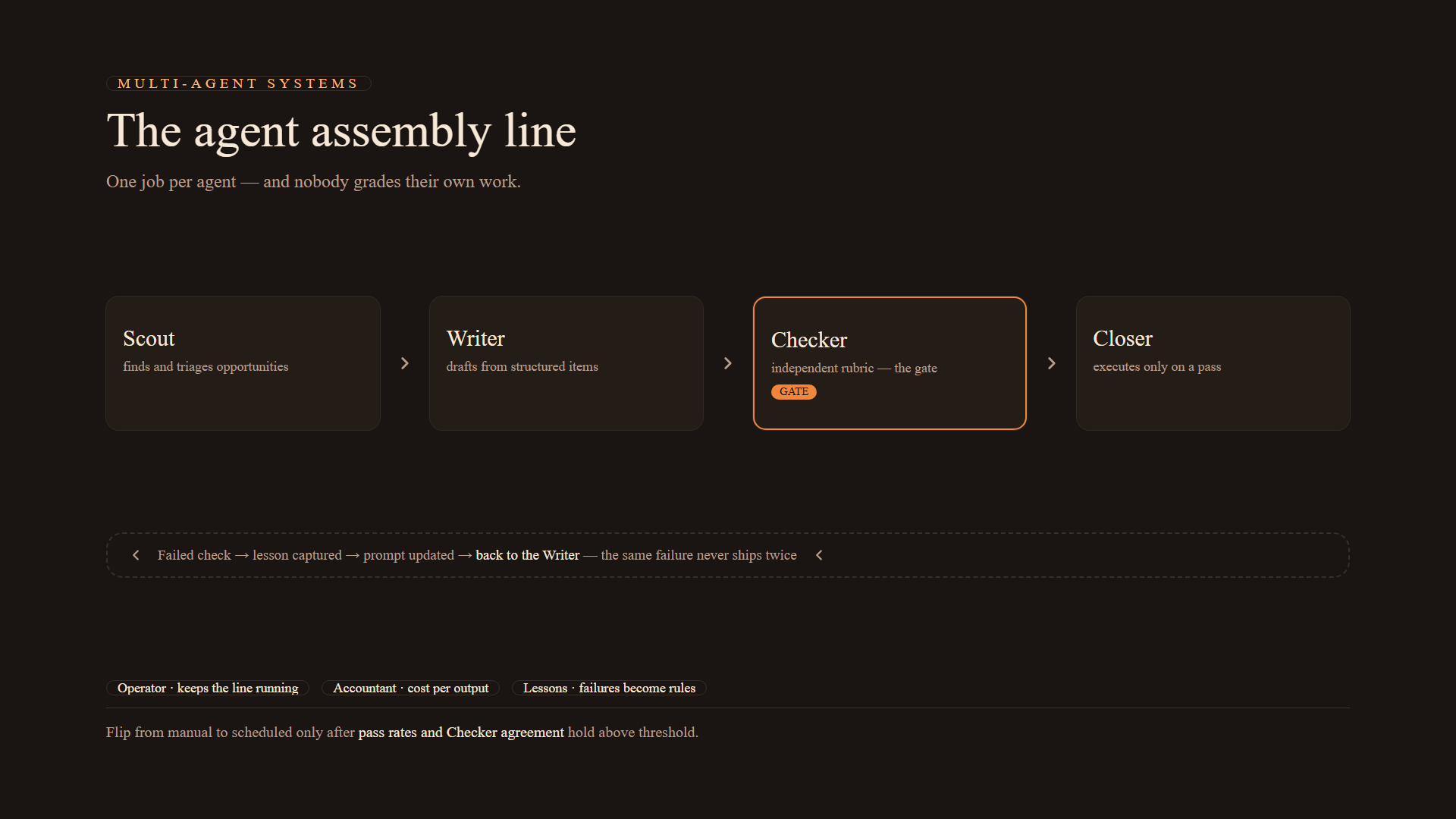
- Scout discovers an item and emits a structured payload with confidence.
- Writer turns it into a draft with metadata.
- Checker grades draft against original payload + rubric.
- Pass → Closer executes (send/post/transaction) with an action record. Fail → the item loops back to Writer with corrections, and a lesson is captured.
- Accountant logs tokens, time, and the financial outcome.
- Operator keeps the queue moving, retries failures, and alerts on stalls.
Cost control: start manual, automate gradually
- Pick the function costing you the most — compute, time, or missed revenue.
- Run that one agent manually, with the Checker in parallel.
- Schedule automation only after pass rates and Checker agreement hold above threshold.
Tactics that keep the bill sane:
# Simple cost model per cycle
scout_cost=$(echo "$items_scanned * $cost_per_scan" | bc)
writer_cost=$(echo "$drafts * $tokens_per_draft * $cost_per_token" | bc)
checker_cost=$(echo "$drafts * $check_cost" | bc)
total=$((scout_cost + writer_cost + checker_cost))
echo "cycle cost: $total | efficiency = value_realized / cost_spent"
- Cap max tokens; route low-risk work to cheaper models.
- Batch — fifty Scout results can feed one Writer run.
- Throttle expensive agents on a cadence (hourly/daily) instead of on every event.
- Let the Accountant page you before the budget does.
The Lessons System: never fail the same way twice
Capture every failure as a structured record, not a vibe:
# lessons/2026-08-19-citation-miss.yml
item_id: item_01J8…
failure_type: factual-accuracy
root_cause: ambiguous_prompt        # | missing_data | hallucination | policy_gap
fix: "require source-quote field before drafting"
produced:
  - prompt_update: "writer@v14 → require verbatim source quotes"
  - rule: "block drafts citing sources older than 24 months"
  - test_case: { input: "…", expected: "…" }
applied_by: human-in-loop
deployed_via: test → staging → production
Classify root causes, deploy lessons through a change pipeline (never straight to production), keep humans in the loop for high-impact changes, and measure success by the recurrence rate of each failure type over time.
Launch your first agent in 10 steps
- Identify the costliest function (time, money, or risk).
- Define the input and output JSON schemas.
- Build the first role (often Scout) to emit structured items.
- Build the downstream consumer that expects that schema.
- Implement a standalone Checker with a rubric.
- Run the pipeline manually; gather 100–500 cases.
- Have humans label a validation set for calibration.
- Tune prompts and rules from Checker feedback.
- Add the Accountant for cost and ROI tracking.
- Flip from manual to scheduled only after thresholds hold.
A concrete example: content production
- Scout scans RSS and keyword alerts → topic candidates with sources.
- Writer drafts 700–1,200 words under a firm style guide.
- Checker verifies facts, screens plagiarism, scores tone and completeness.
- Closer schedules and pushes to the CMS only on a pass.
- Accountant logs token usage, editor time saved, engagement lift.
- Lessons System turns recurring fact errors into site-specific citation rules.
When readers complain about accuracy, you know exactly which two stations to inspect — not "the AI."
Pitfalls and their fixes
- Writer approves its own output → independent Checker, separate model, separate data.
- Free-text handoffs → enforce schema validation at every boundary.
- Automation flipped too early → require thresholds plus a human-reviewed batch.
- One agent doing five jobs → split roles; you debug faster and pay only for what runs.
KPIs worth watching
- Writer↔Checker agreement rate.
- Pass rate trend (catch regressions early).
- Cost per successful output — not per attempt.
- Mean time to remediate failed items.
- Lesson application rate and recurrence drop.
Treat the AI team like a production line: one auditable responsibility per agent, no self-grading, an independent gate before anything ships, and a loop that turns every failure into a rule. That's the difference between chaotic chatbots and a pipeline you can actually trust — and afford.