
If your blog or newsletter has started to feel predictable, the problem usually isn't creativity — it's visibility. You can write solid post after solid post and still miss whole topic areas, because you're standing inside your own pattern. Every writer has formats and angles they instinctively reach for; those ruts are nearly invisible from the inside.
Here's the fix: hand your pattern to a conversational AI, let it map what you actually publish, surface the gaps relative to your goals, and return a prioritized three-month calendar you'd actually publish. Not "give me 20 ideas" — a structured workflow that takes an hour and turns a blind spot into a repeatable editorial routine.
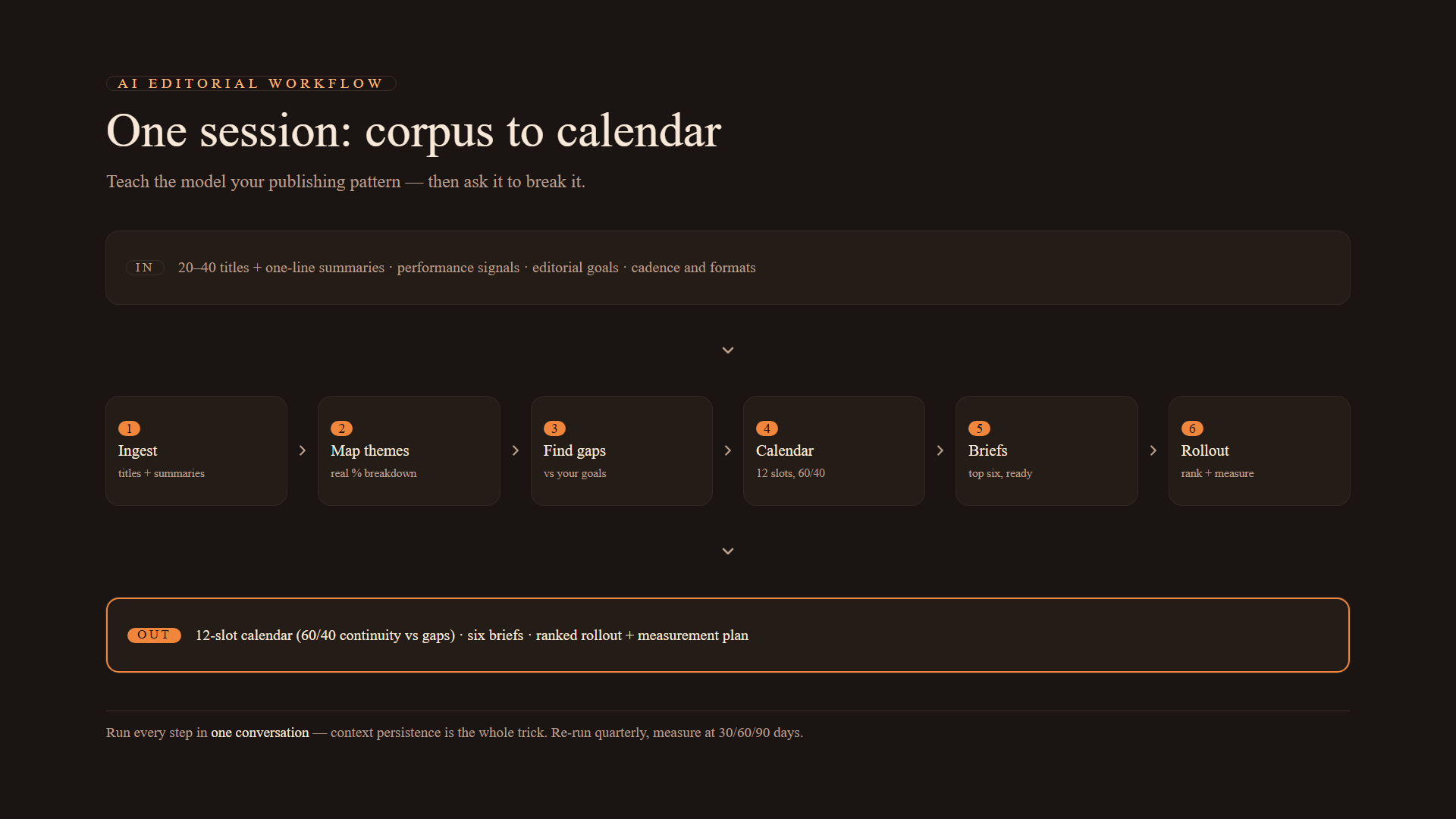
Use a conversational AI for content gap analysis by first teaching it your publishing pattern: paste 20–40 recent titles with one-line summaries, then run a six-step single-session workflow — ingest the corpus, map your real themes with percentages, identify 8–12 underrepresented topic areas against your goals, generate a balanced 12-slot editorial calendar, produce briefs for the top six ideas, and rank them with rollout and measurement plans. Bring performance data for smarter prioritization, humanize every brief before publishing, and re-run the audit quarterly.
Why content gaps are relative
A gap is only a gap against an existing pattern. If half your posts are tactical explainers, you can still be missing the strategic context, case studies, or tool comparisons your readers need to progress. Three things make this hard to see from the inside:
- Blind-spot risk — creators naturally repeat formats that performed before, narrowing the mix over time.
- Opportunity cost — every missed topic is traffic, authority, or product-led acquisition slipping away quietly.
- Intuition misleads — "feels like we cover this" is not data.
And the three ways teams usually get AI to do this wrong:
- Asking for generic ideas without context — you get mediocre, unpublishable bullets.
- Over-trusting intuition about themes — effort goes to the wrong places.
- Treating gap analysis as a one-off instead of a recurring editorial habit.
The principle: teach the model your pattern, then ask it to break it
The workflow is two distinct jobs:
- Build the model's understanding of your corpus — titles, summaries, tags, metrics.
- Ask it to propose structured, prioritized content that intentionally diversifies the mix.
Skip the first step and you get generic lists. Do both and you get ideas that fit your voice but explore angles you've been ignoring.
What to prepare
- 20–40 recent post titles, each with a one-line summary if you have them.
- Performance signals per post (optional but powerful): pageviews, opens, backlinks, time on page.
- The tags or categories you've used historically.
- Your editorial goals for the next quarter — grow organic traffic, support a launch, demonstrate expertise.
- Constraints: cadence, preferred formats, off-limits topics.
The six-step prompt workflow
Run all six steps in one session so context persists — separate chats reset the corpus and you're back to generic output.
Step 1 — Feed the raw material
I'm pasting 30 post titles with one-line summaries below. Read them all
as a set. Don't analyze yet — confirm you've ingested them and say "ready."

[paste titles + summaries]
This forces the model to hold the full corpus in memory and reason across it, rather than reacting to the last line it saw.
Step 2 — Map the real themes
Group these posts into the real themes you see — not my claimed
categories. For each theme: a one-sentence description and the
percentage of my posts that belong there. Call out the top two themes
that dominate.
Expect honest categories, including clusters you never planned: repeated formats, audiences, or a case-study angle that quietly took over. The percentage breakdown makes imbalance undeniable.
Step 3 — Surface the gaps
Share your editorial goals, then:
Given the themes above and my goal of [e.g., increasing organic signups
25% in 3 months], list 8–12 underrepresented topic areas that would move
me toward that goal. For each: Impact (High/Med/Low), Difficulty
(High/Med/Low), which audience it targets, and one sentence on why it
matters.
This beats "give me 20 ideas" because the model evaluates gaps relative to your pattern and your goals — not a generic SEO list.
Step 4 — Generate the calendar
Provide cadence and formats, then ask for a 12-slot calendar. Ask for structured entries you can drop into a spreadsheet:
{
  "week": 5,
  "title": "What 6 months of local-LLM email triage actually saved us",
  "format": "case-study",
  "target_theme": "proof-and-results",
  "effort_hours": 6,
  "primary_kpi": "organic signups",
  "type": "gap"
}
Two balance rules: roughly a 60/40 split between continuity topics and gap-filling ones, and alternating formats (how-to, case study, interview, roundup) so the calendar doesn't read as one long essay.
Step 5 — Brief the top six
For the six highest-value items, request a 250–350 word brief each: audience, pain point, angle, H2/H3 outline, suggested sources or data, SEO keywords, and short social copy. Briefs are what turn ideas into work-ready tasks — and clean handoffs if writers or editors touch them next.
Step 6 — Prioritize and plan rollout
Ask the model to rank the six briefs by potential against your top KPI, then produce a launch checklist, a promotion plan (email, social, repurposing), and a measurement plan per piece.
What "good" looks like
| Benchmark | Expectation |
|---|---|
| Theme balance | No single theme above ~40–50% of the mix — unless that's a deliberate niche strategy |
| Idea-to-publish ratio | ~30–40% of AI ideas publishable with light editing; briefs push it higher |
| Calendar composition (weekly cadence) | 6 continuity pieces + 6 gap-targeted pieces in 12 slots |
| Ideation time | Days → under an hour, plus brief refinement |
Optional upgrades
- Paste raw performance data so prioritization follows signals, not vibes.
- If you prefer statistical grouping, run TF-IDF or k-means clustering first and paste the clusters in.
- With a custom assistant, pre-load the corpus into long-term memory so tone and history persist across sessions.
None of these are required — they sharpen precision, not feasibility.
Measure after you publish
For each calendar item, track organic traffic and keyword rankings at 30/60/90 days, engagement (time on page, scroll depth), conversion events tied to business goals, and social amplification or backlinks. Fold what you learn into the next quarterly audit — this is a loop, not an event.
Pitfalls and fixes
- Titles only, no summaries → add one-liners so the model gets intent, not just keywords.
- Prompts in separate sessions → keep the whole workflow in one conversation.
- Treating output as final → it's a first draft; edit for voice, examples, and factual accuracy.
- Ignoring metrics → bring performance data in so high-opportunity gaps float up.
Humanize the briefs before publishing
- Add one concrete example or case study from your own experience.
- Insert an original quote or anecdote to carry authority.
- Replace abstract claims with numbers or citations.
- Trim AI phrasing and vary paragraph rhythm.
Pro tip: when a brief says "research X," paste the brief back and ask for three reputable sources and two relevant stats to cite.
The quarterly routine
- Export your last 40 posts with titles, summaries, and performance.
- Run the six-step workflow in one session.
- Ship the top two low-effort / high-impact briefs first.
- Measure over 90 days.
- Repeat — feeding results back in each cycle.
Teach the model your pattern, ask it to expose what's missing, and turn that insight into concrete, measured work. That's how a creative blind spot becomes an editorial system.